
China Top USB C Bulkhead Connector Manufacturers
China’s leading USB-C bulkhead connector manufacturers serve a market shaped by faster charging, compact equipment, and demanding installation environments. A bulkhead connector passes through a panel, allowing a secure external connection on industrial controllers, vehicles, test instruments, and sealed enclosures. Small details matter: thread fit, panel thickness, sealing method, and cable strain relief can determine whether a connector performs reliably after repeated use.
The USB Implementers Forum’s USB Power Delivery Revision 3.1 specification supports power levels up to 240 watts with Extended Power Range equipment. That figure makes thermal design, contact quality, and clearly stated product ratings especially important. USB-IF president and COO Jeff Ravencraft has described USB-C as “the one cable that can do it all.” The phrase captures the format’s ambition, though a bulkhead connector still needs careful matching to its cable, device, and operating conditions.
This guide examines China-based suppliers through practical criteria: published specifications, material choices, testing information, customization capability, and communication quality. A polished product page is not proof of field reliability. Buyers should request drawings, compatibility details, and relevant test records before comparing quotations. Look closely. A connector may appear identical in a photograph yet differ in sealing, pin configuration, or mounting tolerance. These differences are easy to overlook, and supplier claims deserve verification. The sections ahead introduce manufacturers and help technical buyers assess each Usb C Bulkhead Connector option with evidence rather than assumptions.
What USB-C Bulkhead Connectors Are and How They Work
China Top USB C Bulkhead Connector Manufacturers
What USB-C Bulkhead Connectors Are and How They Work
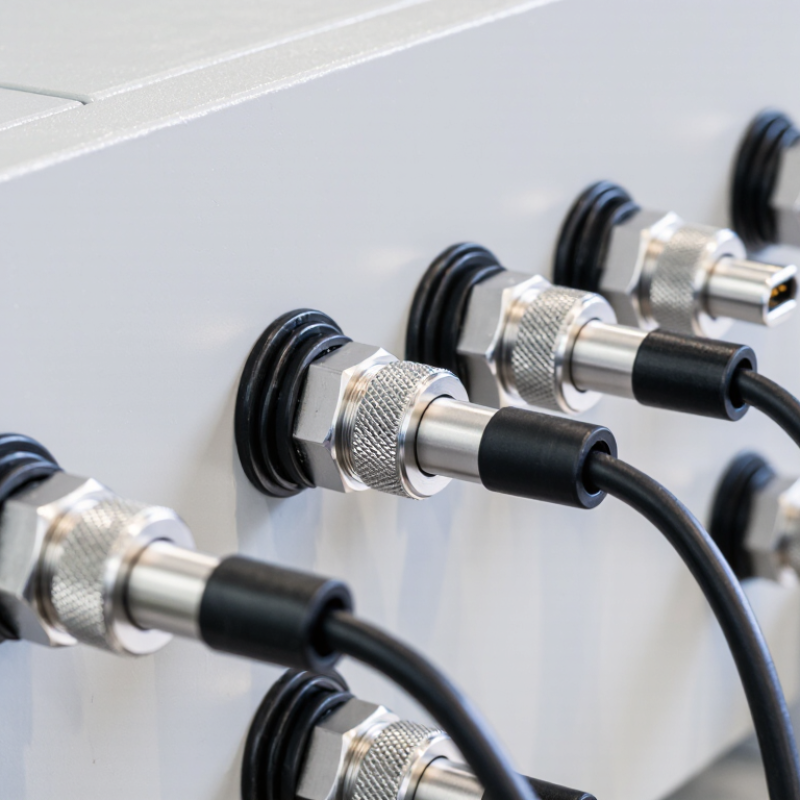
A USB-C bulkhead connector mounts through an enclosure wall, creating an accessible port while keeping internal wiring protected. The outer receptacle accepts a USB-C plug; contacts behind the panel connect to a cable or circuit board. A threaded shell, retaining nut, or gasket may secure the fitting.
Check the panel thickness and cutout dimensions before installation. Even a small mismatch can leave the connector loose or compromise the seal.
The connector carries power and data through matched contacts, but a bulkhead fitting does not set the performance by itself. USB-IF specifications define the Type-C interface, while the cable, host, and connected device determine which functions work. USB-IF’s USB Power Delivery 3.1 documentation allows up to 240 watts with Extended Power Range. Its USB4 Version 2.0 announcement describes data rates up to 80 Gbps.
Not automatically. Those are interface capabilities, not guarantees for every panel connector. Contact quality, cable length, shielding, and assembly all matter.
A practical check is to confirm the rated current and data speed, then test the complete assembly under load.
One detail is easy to overlook: a connector may fit neatly yet still limit signal performance. That trade-off deserves attention.
Key Designs, Materials, and Performance Standards
A USB-C bulkhead connector must do more than fit a panel opening. Its design should protect the interface while preserving stable data and power connections. Threaded, flange-mounted, and snap-in styles suit different enclosure layouts. Check the cutout dimensions, cable clearance, and mating depth before selecting a part. Small gaps matter.
Materials affect service life. Nickel-plated brass offers a practical balance of strength and corrosion resistance, while stainless steel suits demanding environments. The connector body may use an engineering-grade polymer for electrical insulation. Silicone or comparable elastomer seals can help limit moisture entry, but sealing depends on the full assembly, including panel thickness and installation torque. A gasket alone is not a guarantee.
Performance claims need evidence. Confirm that the Type-C interface follows the applicable USB-IF specifications, then check supported data rates and power levels against the intended application. For outdoor or washdown equipment, request ingress-protection test details assessed against IEC 60529. Test assembled units, not only loose connectors. Inspect contact alignment, retention force, and seal compression after repeated mating cycles. In practice, cable quality and assembly variation can change results; specifications do not tell the whole story. A sample fit test may reveal an awkward clearance that a drawing missed.
China’s USB-C Bulkhead Connector Manufacturing Landscape
China’s USB-C bulkhead connector manufacturing landscape combines metal machining, polymer molding, contact finishing, and final assembly. Suppliers may offer panel-mount receptacles with threaded shells, flange mounts, or sealing features. Capability varies by factory, even when product photos look similar. A connector for a dusty control cabinet needs different protection than one inside a test bench. Pin layout, cable clearance, mounting thickness, and required data or power performance should be specified early.
Tips: Request dimensioned drawings, material details, and test records. Check mating fit and panel sealing with your own samples. A polished catalog is not proof of consistent production.
For a useful supplier comparison, ask how incoming contacts, plating thickness, and assembly fit are checked. Confirm whether performance claims apply to the complete connector or only its insert. Sample testing can reveal loose threads, uneven seals, or a stiff mating action. These checks matter more than a broad capability list. I would still leave room for uncertainty: one sample cannot show how a production batch will behave. Clear tolerances and documented inspection steps make that risk easier to assess.
China Top USB C Bulkhead Connector Manufacturers - China’s USB-C Bulkhead Connector Manufacturing Landscape
| Manufacturing Dimension | Common Product Options | Technical Context | Buyer Verification Points |
|---|---|---|---|
| Bulkhead mounting format | Threaded panel-mount receptacles, flange-mounted connectors, and cable-to-panel assemblies | Mounting method and panel cutout depend on the connector housing and installation design. | Confirm cutout dimensions, thread specification, panel thickness range, nut or flange arrangement, and rear clearance. |
| USB-C interface configuration | USB-C receptacle on one or both sides; USB-C-to-USB-C or USB-C-to-other-interface assemblies | The USB-C shape does not by itself establish data rate, charging power, or supported USB features. | Request the pin assignment, wiring diagram, orientation behavior, and supported functions for the complete assembly. |
| Data transmission | USB 2.0-only wiring or assemblies designed for higher-speed USB data | USB 2.0 supports signaling rates up to 480 Mb/s. Higher USB data rates require suitable contacts, cable construction, and signal integrity. | Check the declared USB generation, tested link rate, cable length, shielding, and any limitations caused by the bulkhead assembly. |
| Power delivery | Power-only, USB 2.0 charging, or USB Power Delivery-capable configurations | USB Power Delivery capability depends on the complete system. USB PD 3.1 defines Extended Power Range operation up to 240 W with compatible equipment and cables. | Verify rated voltage and current, power-delivery negotiation support, cable rating, thermal performance, and applicable certifications. |
| Ingress protection | Unsealed, gasket-sealed, or capped designs; some assemblies are specified with an IP rating | An IP rating applies to a defined test configuration. Mating state, cap use, gasket installation, and panel assembly can affect protection. | Ask for the test report and confirm whether the rating applies when mated, unmated, capped, and installed in the intended panel. |
| Housing and contact materials | Metal or polymer housings; conductive contact alloys with specified surface finishes | Material selection affects mechanical strength, corrosion behavior, electrical performance, and suitability for the operating environment. | Obtain material and plating specifications, operating-temperature limits, corrosion-test details, and any restricted-substance declarations required. |
| Environmental and mechanical design | Options for vibration exposure, repeated mating, outdoor enclosures, or industrial equipment | Durability depends on the complete connector and installation, not solely on the USB-C interface format. | Review mating-cycle ratings, retention method, vibration or shock test conditions, and strain relief for attached cables. |
| Customization and production | Customized cable length, lead orientation, panel hardware, labeling, and packaging | Custom assemblies may require separate drawings, samples, and validation before volume production. | Confirm approved drawings, sample testing, change-control procedures, inspection criteria, traceability, and production lead times. |
| Quality and compliance documentation | Electrical test records, dimensional inspection, material declarations, and product-specific compliance documents | Standards and regulatory requirements depend on the destination market and the end product. | Request documents for the exact part and configuration; verify that certificates or test reports cover the supplied assembly. |
Note: This table summarizes common product and manufacturing considerations for USB-C bulkhead assemblies. It is not a verified ranking or a claim about the capabilities of any specific manufacturer. Confirm all ratings against the exact product datasheet and test documentation.
How to Evaluate and Compare Chinese Manufacturers
When comparing Chinese USB-C bulkhead connector manufacturers, match the exact part to your operating conditions. Check rated current, data capability, panel thickness, mounting method, and ingress protection. USB-C describes the connector shape, not guaranteed charging speed or data performance. Ask for model-specific drawings and test reports, then confirm that reported results cover your chosen configuration. Small details matter. A connector that fits a 2 mm panel may not seal reliably on a thicker enclosure.
IDC’s Worldwide Quarterly Mobile Phone Tracker reported 1.24 billion smartphone shipments in 2024, up 6.4% year over year. This signals continued use of USB-C devices, but it does not prove demand for any particular bulkhead connector. Compare suppliers on evidence: request traceable material specifications, plating details, inspection criteria, and sample results for mating cycles or environmental tests. IEC 60512 test methods can help define connector tests; IEC 60529 ratings help clarify enclosure protection. Be cautious when a quotation lists standards without naming the tested model. That gap is easy to miss.
Tips: Send every candidate the same drawing and test checklist. Compare samples under real installation conditions, including cable strain and panel fit. Keep one unresolved question in your notes; supplier answers can reveal where specifications are still vague.
Leading Manufacturers and Their Product Specialties
China’s USB-C bulkhead connector manufacturers often specialize in different installation needs. Some focus on panel-mount couplers for equipment enclosures, using threaded collars, sealing rings, and metal housings. Others produce compact pass-through designs for control cabinets, test instruments, or vehicle interiors. Fit matters. A connector may look robust but still loosen if its panel thickness range does not match the enclosure.
Product specialties also vary by electrical design. Manufacturers may offer USB 2.0 versions for basic peripherals, or higher-speed options with carefully routed internal conductors. Some supply pigtail assemblies, while others provide solder-cup or PCB termination styles. That detail counts. A USB-C shape alone does not confirm supported data rates or charging performance; buyers should check pin configuration, current rating, cable length, and test documentation. For damp or dusty settings, ask how the sealing system was evaluated, rather than relying on a broad “waterproof” description. Specifications can be incomplete, and that deserves a second look. Requesting drawings and sample units helps verify mounting dimensions, mating force, and clearance before a production order.