
China Top 10 Toggle Switch Manufacturers?

A Toggle Switch may look simple, but the wrong specification can cause installation delays, premature wear, or a poor fit. Buyers comparing manufacturers in China should look beyond price and product photos. Check the operating current and voltage, contact configuration, terminal style, mounting dimensions, and expected mechanical life. A lever that feels solid in a sample is useful, but it does not prove consistent production quality. Details matter.

This guide introduces ten Chinese manufacturers and offers a practical starting point for supplier research. It considers product range, customization options, manufacturing information, and the clarity of available technical documentation. Look for current datasheets, dimensional drawings, and test details that match the exact model being quoted. Ask for evidence. A catalog may show many variations, while the factory’s standard production range is narrower. That distinction matters. For applications with demanding environmental or performance requirements, confirm the relevant ratings and certifications directly with the supplier; do not assume they apply to every switch. Manufacturer information can change, and public listings may not reveal production capacity or quality controls. Treat this overview as a shortlist, not a final endorsement. Compare samples, request written specifications, and clarify lead times before making a purchasing decision. No list can replace careful verification.
China Top 10 Toggle Switch Manufacturers?

Toggle Switches: Definition, Operating Principles, and Common Applications

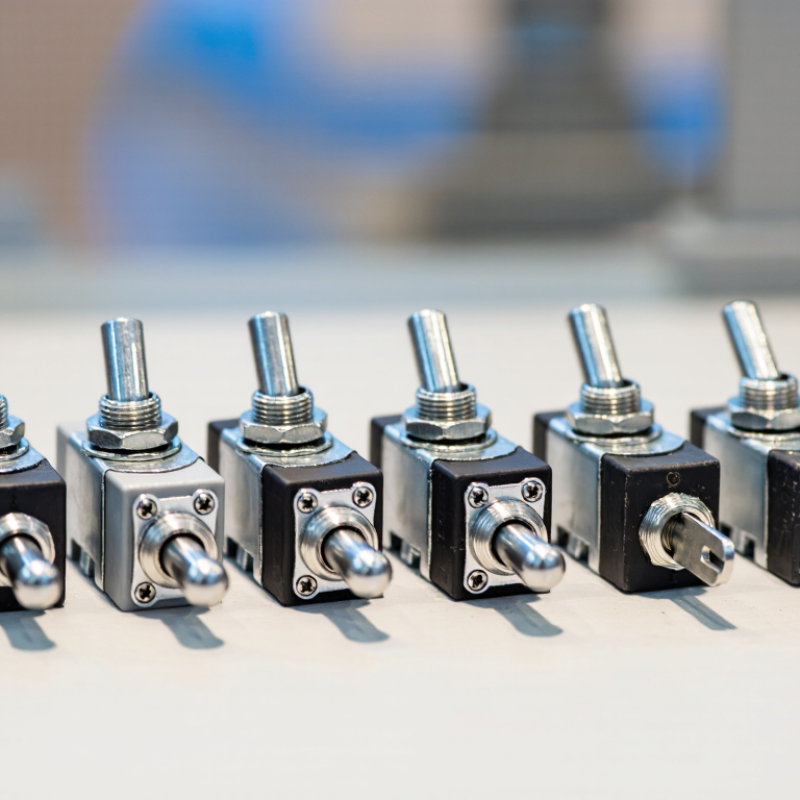
A toggle switch is a manually operated device that opens, closes, or redirects an electrical circuit. Its lever moves an internal mechanism, bringing conductive contacts together or separating them. In a maintained switch, the lever stays in position; in a momentary type, it returns when released. That is the core. Contact arrangement matters too: a single-pole, single-throw switch controls one circuit, while more complex arrangements can change between circuits. The small lever is simple, but the wrong rating can cause overheating or early failure.

Toggle switches appear on control panels, lamps, test equipment, and some vehicle accessories. Their clear positions make them useful when an operator needs to see whether a circuit is on or off. A momentary switch can suit a machine control that should activate only while pressed. Not every application needs a toggle, though; vibration, moisture, and frequent operation can affect performance. Check the rated voltage and current against the actual load, and consider the enclosure and mounting method. One easy mistake is choosing by appearance alone. I would also verify the switch’s wiring diagram before installation, since terminals that look similar may serve different functions.

Toggle Switch Configurations: Terminal Counts and Uses

A toggle switch uses a lever to mechanically move electrical contacts between circuit positions. Pole count indicates how many separate circuits the switch controls; throw count indicates the available contact paths.

How to read the chart: The terminal counts shown are the standard contact terminals for each configuration; physical switches may have additional terminals for features such as indicator lights. SPST switches commonly control a single on/off circuit, while multi-pole or multi-throw types can control multiple circuits or select between circuit paths.

Types and Key Specifications of Toggle Switches

Toggle switches differ by pole count, throw count, and operating action. SPST controls one circuit; SPDT selects between two circuits. DPDT switches two circuits at once, useful when polarity or paired signal paths must change. Some levers stay in position, while momentary types return when released. Simple, but not interchangeable.

Check the nameplate and datasheet. Rated voltage and current must suit the load, not just the supply. IEC 61058-1:2016 covers appliance switches with ratings up to 480 V and 63 A; that scope is not a rating for every toggle switch. Contact resistance, insulation strength, terminal style, and mechanical and electrical life also matter. For outdoor equipment, inspect the stated IP rating under IEC 60529. A resistive-load rating may not apply to a motor or lamp with high startup current. This detail is easy to miss.

Choose ON-OFF for isolation, ON-ON for circuit selection, or ON-OFF-ON when a neutral position is needed. Check panel-hole diameter and lever clearance before ordering. Datasheets can omit useful life-test conditions, so compare test loads carefully. A small mismatch here can shorten service life.

China’s Toggle Switch Manufacturing Landscape

China’s toggle-switch manufacturing landscape is supported by a broad electrical-equipment supply chain. The National Bureau of Statistics reported 12.9% growth in value added for China’s electrical machinery and equipment manufacturing industry in 2023. This is a useful indicator of industrial momentum, not a measure of toggle-switch production. The distinction matters. Manufacturers serve industrial controls, vehicles, appliances, and equipment panels, where switch size, terminal layout, and operating feel can vary considerably. Nearby suppliers of metal stampings, molded housings, and contact materials can also help shorten production cycles.

The market is competitive, but catalog specifications alone reveal little about consistency. Grand View Research valued the global electrical switches market at US$15.44 billion in 2023 and forecast 6.3% annual growth through 2030. That report covers electrical switches broadly, not toggle switches alone. Small parts, serious work. Buyers should examine sample performance, contact resistance data, mechanical life testing, and inspection records. A crisp lever action may feel reassuring, yet it cannot prove long-term reliability. I would also ask how a factory handles tolerance drift between production batches. That detail is easy to overlook, and supplier documents do not always make it clear.

China Top 10 Toggle Switch Manufacturers? – China’s Toggle Switch Manufacturing Landscape

A practical comparison framework for evaluating manufacturers; entries describe product and production capabilities, not ranked or identified companies.

# Evaluation dimension Common options or relevant facts What buyers should verify
1 Switching function Common toggle configurations include SPST, SPDT, DPST, and DPDT. Pole and throw count describe the number of circuits controlled and available contact paths. Confirm the required circuit diagram, terminal layout, and maintained or momentary action.
2 Electrical ratings Voltage, current, load type, and electrical life are product-specific. Resistive, inductive, and motor loads can impose different switching demands. Check the datasheet’s AC/DC ratings and load conditions; do not infer a rating from the switch’s appearance or size.
3 Actuation and positions Toggle switches may use maintained or momentary action, with two or more mechanical positions depending on design. Request the position/function table and confirm which positions are momentary, maintained, or spring-return.
4 Mounting and panel fit Panel-mount toggle switches are available with different bushing, thread, panel-thickness, and terminal arrangements. Compare the dimensional drawing with the panel cutout, clearance, and wiring space in the end product.
5 Terminals and connections Common connection styles include solder lugs, screw terminals, and quick-connect terminals; compatibility depends on the selected series. Check terminal dimensions, wire range, assembly method, and applicable connection requirements.
6 Ingress protection IP classifications are defined by IEC 60529. Protection depends on the complete installed assembly, including seals and panel interface. Request the exact IP rating and test scope; verify whether it applies to the switch alone or to an installed configuration.
7 Materials and environment Housing, actuator, seals, and contact materials vary by design. Operating temperature and resistance to vibration or corrosion are model-specific. Review material declarations and environmental limits against the actual application and installation conditions.
8 End-use standards IEC 61058-1 covers switches for appliances; IEC 60947-5-1 covers control-circuit devices and switching elements. The applicable standard depends on intended use. Ask for current, model-specific test reports or certification records relevant to the destination market and end product.
9 Quality and traceability Quality systems, inspection plans, lot records, and change-control practices are supplier-specific; certification of a management system does not certify every product. Review the quality-system scope, incoming and final inspection criteria, batch traceability, and notification process for design changes.
10 Customization and supply capability Options such as actuator shape, markings, wire leads, packaging, and private-label preparation depend on the manufacturer and order requirements. Confirm sample approval, tooling ownership, minimum order quantity, lead time, and production-change controls in writing.

Ratings, certifications, lead times, and customization options must be verified for the specific model and supplier; this table does not represent a verified ranking.

How to Evaluate and Select a Toggle Switch Manufacturer

China Top 10 Toggle Switch Manufacturers?
How to Evaluate and Select a Toggle Switch Manufacturer

A strong supplier proves performance with test records, not polished catalogs. Grand View Research estimated the global electrical switches market at about USD 14 billion in 2023; this broad market figure signals competition, not product quality. Compare manufacturers using the same checklist: rated voltage and current, contact material, mechanical life, operating temperature, and traceable production controls. Ask for test results under IEC 61058-1, then confirm they match your exact load. A lever that feels smooth at room temperature may behave differently after repeated switching or vibration.

Tips: Request samples from the production line, not specially prepared prototypes. Test at least three units under your real electrical load, and record contact resistance before and after cycling. Ask how defects are logged and corrected. ISO 9001 certification can support process consistency, but it does not prove a switch suits your application. A spreadsheet can look convincing. It cannot reveal a sticky lever.

Check whether the supplier can provide stable lead times, material declarations, and clear change-control procedures. Review recent inspection records and ask who owns corrective actions when a batch fails. Small details matter: terminal fit, mounting-hole tolerance, and label durability can slow assembly. I would not rank suppliers by price alone; that shortcut is tempting, and sometimes wrong. A short pilot order helps expose gaps before full production.

Profiles of 10 Leading Toggle Switch Manufacturers in China

China’s toggle-switch sector includes manufacturers with distinct strengths, from compact controls to rugged industrial assemblies. “Top” depends on the application, so these profiles focus on capabilities rather than an unsupported ranking.

One manufacturer profile centers on miniature switches for tight control panels.
Another serves equipment builders needing sealed housings and clear actuation.
A third emphasizes metal levers and durable panel mounting.
A fourth focuses on high-volume production and consistent dimensions.
A fifth offers custom terminals for specialized wiring layouts.
A sixth develops multi-position switches for machinery controls.
A seventh works with low-current applications where contact stability matters.
An eighth supplies illuminated toggle options for visible status indication.
A ninth supports small-batch orders and prototype revisions.
A tenth combines switch assembly with testing and inspection services.

Details vary by model.

For buyers, useful evidence includes dimensional drawings, rated electrical loads, endurance-test methods, and inspection records. Ask how samples are checked against production units. Request clear lead times, too. A polished catalogue alone proves little. Some suppliers may describe similar capabilities, while actual tolerances and test coverage differ. Compare the specific switch, not just the factory profile.

CONTACT US