
Top 10 Firefighting Drones for Global Buyers

Firefighting Drones are changing how emergency teams see heat, smoke, and danger. A thermal camera can scan a warehouse roof before crews climb it. A loudspeaker can guide residents through a dark, smoke-filled street. Yet the technology is not magic. Battery limits, wind, signal loss, and operator training still matter.

The International Civil Aviation Organization highlights unmanned aircraft as valuable tools for emergency response and disaster management. The Federal Aviation Administration also reports continued growth in commercial drone operations, including public-safety missions. MarketsandMarkets’ 2024 drone industry analysis identifies public safety as a major adoption area, while Grand View Research documents strong expansion across commercial drone applications. These reports support the market direction, but they do not guarantee field performance.

Charles Werner, founder of DRONERESPONDERS and a former fire chief, describes drones as “a force multiplier for public safety agencies.” That phrase fits the best use case. A drone does not replace a trained incident commander. It provides earlier information.

This guide reviews the Top 10 Firefighting Drones for Global Buyers. The comparison considers thermal imaging, flight endurance, obstacle avoidance, payload options, weather resistance, software integration, and service support. Price matters too.

Small details matter.

A camera may detect a hot spot but miss structural instability. A powerful aircraft may become impractical without local maintenance. Buyers should also examine aviation rules, privacy requirements, pilot certification, and data security before purchase. The ranking is useful, but imperfect. Real firegrounds are noisy, wet, unpredictable, and rarely as simple as a product brochure suggests.
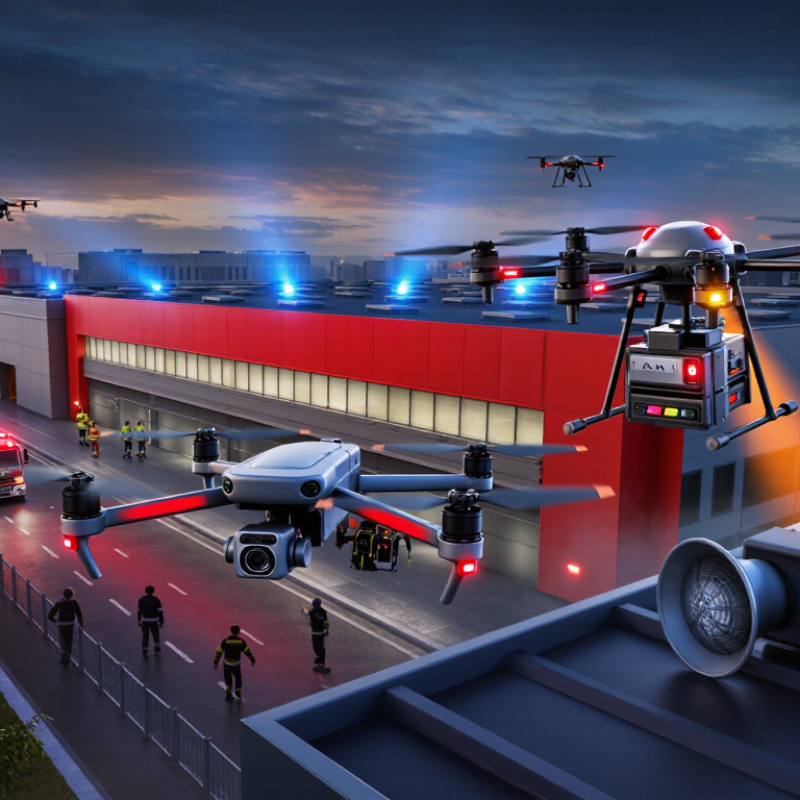
Top 10 Firefighting Drones for Global Buyers

What Firefighting Drones Are and How They Support Emergency Response

Firefighting drones are unmanned aircraft designed to support crews during dangerous emergency operations. They use thermal cameras, zoom sensors, lights, and loudspeakers to observe conditions from above. Some models also carry small payloads, such as flotation devices or communication tools. Their value is practical: a drone can check a burning roof before firefighters climb it.

The U.S. Fire Administration recorded about 1.39 million fires in 2023, according to its National Fire Incident Reporting System data. NFPA also estimated 3,670 civilian fire deaths that year. These figures show why faster scene intelligence matters. A drone can identify heat pockets, blocked access routes, trapped vehicles, or changing smoke movement within minutes. It can send live video to an incident commander, helping crews position hoses and manage evacuation zones. In wildland incidents, thermal imaging may reveal hotspots hidden beneath smoke or vegetation.

The equipment is not magic. Wind, rain, smoke, battery limits, and signal loss can reduce its usefulness. Evidence is still uneven across regions and mission types. NFPA’s U.S. Fire Department Profile reported roughly 1.04 million firefighters, with about 65% serving as volunteers. Drones may reduce unnecessary exposure, but trained operators and clear command procedures remain essential. Buyers should examine flight endurance, thermal accuracy, night performance, data security, maintenance support, and operator training. A bright screen cannot replace field judgment.

Key Features and Evaluation Criteria for Global Buyers

Top 10 Firefighting Drones for Global Buyers

Key Features and Evaluation Criteria for Global Buyers

A capable firefighting drone must deliver useful information, not impressive advertising. NFPA’s Fire Loss in the United States During 2023 estimated 1,504,500 fires. That scale demands reliable thermal imaging, stable flight, and rapid deployment. Buyers should compare thermal resolution, optical zoom, smoke penetration, and image transmission range. A clear heat map can reveal trapped occupants, roof hotspots, or hidden fire spread within seconds.

Payload capacity also matters. Water tanks, loudspeakers, searchlights, and gas sensors increase operational value. However, heavier payloads reduce endurance. Published flight time often reflects calm weather and no payload. Field testing should measure performance in wind, heat, smoke, and low visibility. I would treat maximum range claims cautiously. Real buildings, terrain, and network congestion can reduce control distance.

Safety and compliance require equal attention. NFPA 2400 provides guidance for small unmanned aircraft systems used by emergency services. Buyers should verify obstacle avoidance, return-to-home functions, encrypted communication, battery monitoring, and maintenance records. The European Union Aviation Safety Agency also emphasizes risk-based operation and pilot competence. Training evidence matters. So does repair support.

A lower-cost unit may fail during the critical minute. Yet the most expensive option is not automatically the best. Independent demonstrations, documented test results, and local regulatory review should influence the final decision. Manufacturers sometimes omit payload-related endurance data. That omission deserves scrutiny.

Top 10 Firefighting Drones by Capability and Use Case

Top 10 Firefighting Drones for Global Buyers

Top 10 Firefighting Drones by Capability and Use Case

Firefighting drones now support safer decisions in difficult environments. Thermal imaging drones locate trapped people, hidden hot spots, and weak roof areas. High-zoom camera drones inspect towers, warehouses, and industrial structures from a safer distance. Night-operation drones help crews monitor smoke movement after sunset. Compact indoor drones can enter narrow corridors, though signal loss remains a serious weakness.

Water-delivery drones target small flames before crews approach. Heavy-lift drones carry hoses, sensors, or emergency lighting over damaged ground. Long-endurance drones watch forest edges and identify changing fire lines. Mapping drones create updated terrain models for evacuation planning. Communications-relay drones extend radio coverage in valleys or dense urban areas. Search-and-rescue drones combine thermal cameras, loudspeakers, and spotlight systems. Each capability serves a different incident. More features do not always mean better performance.

Tips: Match the drone to the mission, not the brochure. Check flight time with the full sensor load. Test thermal accuracy around smoke, rain, and reflective surfaces. Confirm weather resistance, pilot training, maintenance support, and data security. Request field evidence from comparable incidents. A drone may look powerful on paper but perform poorly in strong wind. Teams should also practice manual recovery, because automated flight can fail near cranes, trees, or unstable structures. Flexible planning matters.

Comparing Flight Performance, Safety Systems, and Payload Options

Top 10 Firefighting Drones for Global Buyers

The top ten firefighting drones differ most in flight endurance, control stability, and operating range. A strong aircraft should hold position near smoke, towers, and uneven terrain. Flight time matters, but battery replacement speed matters too. Weather changes fast. Wind resistance above 35 km/h can improve mission reliability, although manufacturers may test under ideal conditions. Buyers should check climb speed, thermal-camera clarity, signal range, and return-to-home accuracy. These details often matter more than headline specifications.

Safety systems deserve equal attention. Obstacle detection, geofencing, low-battery alerts, and redundant navigation reduce avoidable mistakes. Thermal imaging can locate hotspots through smoke, while zoom cameras help teams inspect roofs from safer distances.

However, sensors can lose accuracy in heavy smoke, rain, or reflective environments. Operators should verify performance through documented trials, not only laboratory claims. Payload options also shape real usefulness. Common choices include thermal cameras, loudspeakers, spotlights, water mist modules, and compact emergency supplies. Heavier payloads reduce endurance. That trade-off is easy to underestimate.

Tips: Compare payload weight with real flight time, not empty-aircraft figures. Request safety-test records and training requirements. Check local aviation rules before deployment. Keep spare batteries in approved storage. A simple preflight checklist prevents more failures than expensive software. Buyers should also admit one limitation: no drone replaces trained emergency crews or careful judgment. Safety systems assist people; they do not remove responsibility.

How to Select, Purchase, and Operate a Firefighting Drone Internationally

Selecting a firefighting drone for international use requires more than comparing camera resolution. Assess thermal imaging quality, flight endurance, wind resistance, water protection, and night-operation performance. A reliable platform should identify heat through smoke and stream stable video to incident commanders. It should also carry batteries, sensors, or compact illumination equipment safely. A drone is not a magic shield.

Before purchasing, verify local aviation, radio, privacy, import, and emergency-service requirements. Ask for test reports, operator manuals, battery transport guidance, and service availability in your region. Confirm whether replacement batteries, spare propellers, and software support can reach your location. The cheapest quotation may become expensive after customs delays and unavailable parts. That mistake is easy to make.

Operation needs trained pilots, clear airspace control, and documented pre-flight checks. Crews should practice around towers, power lines, smoke, heat, and poor visibility before real deployments. Keep flight logs and inspect batteries after every mission. Combine drone images with ground reports; thermal data can mislead crews near reflective metal or dense structures. A first shortlist may still be wrong. Reassess it after a supervised field trial, because weather, terrain, and local procedures often reveal weaknesses that brochures hide.

Top 10 Firefighting Drones for Global Buyers - How to Select, Purchase, and Operate a Firefighting Drone Internationally

Rank Drone Configuration Primary Firefighting Role Typical Maximum Take-Off Mass Useful Payload Typical Flight Time Thermal Imaging Suppression Capability Typical Operating Range Weather and Environment Indicative Acquisition Cost International Purchase Considerations
1 Heavy-lift multirotor with thermal payload Close-range reconnaissance, hotspot mapping, and incident-command overwatch 25–75 kg 5–20 kg 20–40 minutes Radiometric thermal camera, visible camera, optional laser rangefinder Usually none; may carry a small suppressant or marker payload 3–10 km from the control station, subject to local rules Light rain and moderate wind only when specifically certified US$25,000–US$100,000 Confirm radio-frequency approval, spare batteries, thermal-camera export controls, and pilot certification.
2 Tethered observation multirotor Persistent aerial monitoring above a fireground, industrial site, or evacuation zone 15–45 kg, excluding ground station 2–8 kg 4–12 hours while tethered Stabilized thermal and daylight camera; continuous video downlink Not normally designed for suppression Typically 50–150 m tether height Best for controlled perimeters; tether handling is difficult in high wind and dense vegetation US$30,000–US$120,000 Check tether safety procedures, grounding, local aviation restrictions, and compatibility with emergency networks.
3 Water- or foam-carrying multirotor Targeted suppression of small external fires and cooling of exposed structures 25–100 kg 10–40 L of water or foam solution 8–25 minutes when fully loaded Recommended for identifying flame edges and residual heat Pump, spray bar, or drop tank; limited by payload volume and refill time 1–5 km practical mission radius Requires corrosion-resistant components and careful operation near smoke, heat, and turbulence US$40,000–US$180,000 Verify liquid-transport rules, pressure-system certification, approved extinguishing agents, and decontamination procedures.
4 Long-endurance fixed-wing mapping UAV Wildland-fire perimeter mapping, smoke-plume assessment, and large-area intelligence 5–25 kg 0.5–5 kg 1.5–8 hours Optional thermal payload; multispectral and high-resolution RGB cameras are common None 20–100 km mission radius, depending on communications and airspace approval Efficient in open terrain; requires launch and recovery area and is less suitable for tight urban sites US$15,000–US$90,000 Plan for beyond-visual-line-of-sight authorization, detect-and-avoid requirements, and approved recovery procedures.
5 Hybrid VTOL mapping UAV Large-area wildfire surveillance with vertical take-off and fixed-wing endurance 10–35 kg 1–8 kg 2–10 hours Thermal, RGB, and optional gas or particulate sensors None 30–150 km mission radius with suitable command-and-control links Suitable where runways are unavailable; transition operations require trained crews US$35,000–US$160,000 Assess airspace classification, flight termination requirements, battery transport, and local maintenance capability.
6 Indoor inspection micro-multirotor Inspection of warehouses, tunnels, buildings, and industrial rooms unsafe for first responders 0.25–3 kg 0.05–0.5 kg 8–25 minutes Compact thermal sensor and low-light camera; obstacle protection is highly valuable None 100–500 m indoors, depending on structure and radio interference Choose protected propellers, collision lighting, and heat-resistant accessories for confined spaces US$3,000–US$30,000 Check hazardous-area requirements, data-protection rules, battery handling, and indoor-pilot training.
7 Gas- and air-quality sensing multirotor Detection of carbon monoxide, volatile compounds, smoke movement, and hazardous atmospheres 5–30 kg 0.5–5 kg 20–45 minutes Thermal camera commonly paired with gas, particulate, or weather sensors None 2–8 km from the pilot, depending on terrain and communications Sensor readings are affected by wind, humidity, calibration, and smoke composition US$20,000–US$100,000 Confirm sensor calibration standards, hazardous-location use, laboratory support, and data-retention obligations.
8 Search-and-rescue payload multirotor Locating trapped people, delivering radios or medical items, and guiding rescue teams 8–35 kg 1–10 kg 25–50 minutes Thermal, zoom, low-light, spotlight, speaker, and loudhailer options May release a small emergency kit; not intended for fire suppression 5–15 km with a reliable command link Select obstacle avoidance, redundant navigation, and stable hovering for smoke-affected areas US$15,000–US$85,000 Coordinate with emergency services, secure personal data, and establish procedures for operating over people.
9 Night-operation thermal multirotor Night patrols, fire-line verification, hotspot detection, and post-fire inspection 2–25 kg 0.2–5 kg 25–55 minutes Radiometric thermal camera with calibrated temperature measurement None 3–12 km, depending on the communications system and terrain Night flight, smoke, and low visibility require additional risk controls and lighting US$8,000–US$70,000 Obtain night-operation approval where required and train crews to interpret thermal images correctly.
10 Coordinated multi-drone response system Combines mapping, thermal observation, communications, and logistics during complex incidents Varies by aircraft; commonly 2–75 kg per drone 0.2–20 kg per drone 15 minutes–8 hours, depending on aircraft type Shared thermal, RGB, mapping, gas, and communications payloads Usually indirect support; suppression aircraft may be added separately Multiple overlapping operational areas within authorized airspace Requires centralized mission planning, frequency coordination, and robust incident procedures US$75,000–US$350,000 or more Review fleet-level certification, cybersecurity, cross-border data transfer, insurance, and operator staffing.
Buyer note: The specifications and price bands are indicative ranges for internationally available civil unmanned-aircraft configurations. Actual performance depends on payload, battery condition, altitude, temperature, wind, smoke, communications coverage, and national aviation regulations. Confirm certification, import requirements, radio-frequency approval, insurance, pilot licensing, maintenance support, and export-control status before purchase.

CONTACT US