
Top 10 Automated Palletizing Robot Suppliers Worldwide
An Automated Palletizing Robot can turn a busy end-of-line station into a steady rhythm of lifted cases, precise layer placement, and finished pallets. But choosing a supplier is not just a question of robot speed. Payload, reach, gripper design, floor space, controls, integration support, and service coverage all affect real-world performance.
Industry figures show why automation deserves closer attention. The International Federation of Robotics (IFR), in World Robotics 2024, reported 541,302 industrial robots installed worldwide in 2023, with a global operational stock of about 4.28 million. These figures cover industrial robots broadly, not palletizers alone. They offer context, not a palletizing market estimate. In a 2021 IFR statement, then-president Milton Guerry said, “The global robot density in factories has doubled in just seven years.” The trend is clear. The right investment is less clear.
This guide compares 10 suppliers serving palletizing applications worldwide. It focuses on practical distinctions: standard versus custom cells, mixed-SKU handling, integration options, and support after commissioning. A fast cycle time can look impressive on a specification sheet. A poorly matched gripper or cramped safety layout can matter more on the plant floor. Supplier claims also need scrutiny; published performance figures may depend on the product, pattern, and operating conditions. No ranking can replace a site assessment, but a careful shortlist can make that assessment more useful.
Automated Palletizing Robots: Core Functions and System Types
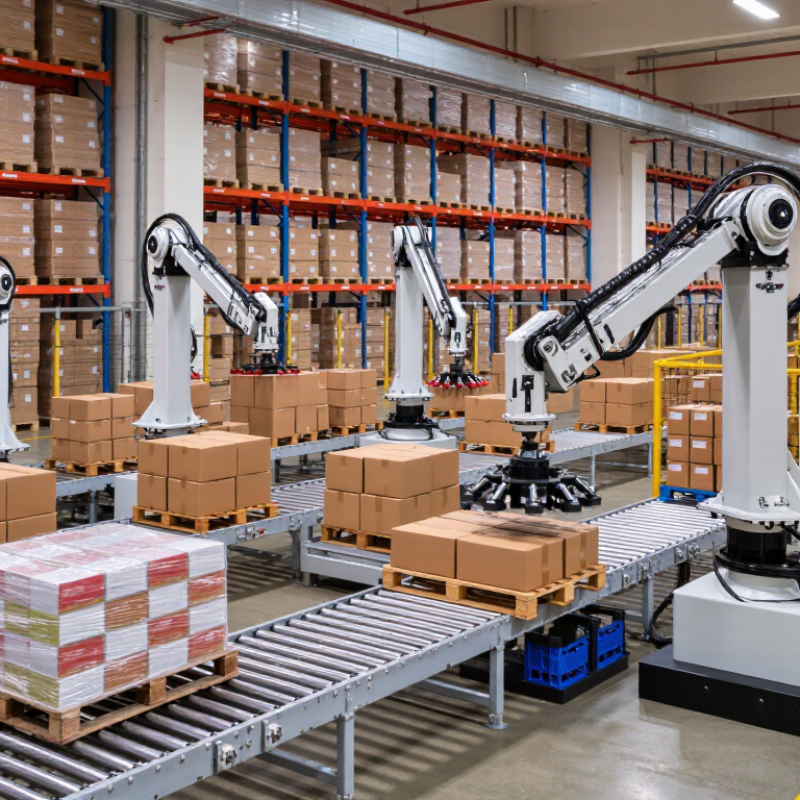
Automated palletizing robots do more than stack cartons. A complete cell identifies product position, grips each load, follows a programmed pattern, and places cases steadily on a pallet. Vacuum heads suit many sealed cartons; mechanical clamps can handle loads that are porous or irregular. Sensors check pallet position and layer height. In practice, damaged cartons and shifting bags still challenge even well-tuned systems. Small details matter.
Common system types include articulated-arm robotic cells, gantry systems, and conventional layer palletizers. Articulated arms offer flexible reach and can switch between patterns with a recipe change. Gantry units move across a fixed frame, making them useful for wide work areas. Layer palletizers arrange whole rows at once and can deliver high throughput, but often allow less layout flexibility. Add-ons may include pallet dispensers, slip-sheet placement, and conveyorized pallet removal. The right setup depends on case weight, line speed, floor space, and product variation.
Industry context helps explain the investment, but should not be mistaken for palletizer-specific demand. The International Federation of Robotics reported 541,302 industrial robot installations worldwide in 2023, in its World Robotics 2024 report. That figure covers many industries and robot applications, not palletizing alone. For buyers, the practical test is a representative run: include mixed case sizes, realistic line stops, and the actual pallet pattern. Looks good on paper. Then comes the awkward part: confirming stable performance during changeovers and routine maintenance.
Criteria for Comparing Global Palletizing Robot Suppliers
When comparing global palletizing robot suppliers, start with the load, not the headline speed. Record carton weight, pallet height, pattern changes, and required cases per minute. Then check payload and reach against the real layout, including the space needed for guarding and maintenance. Fit matters more than brochure speed.
The International Federation of Robotics reported 541,302 industrial robot installations worldwide in 2023, with Asia accounting for about 70% of new installations (World Robotics 2024). This scale makes local commissioning and spare-parts access practical comparison points. Ask suppliers for response times, technician coverage, and references from similar packaging lines. A polished demo is not enough.
Compare quoted cycle times under the same conditions: product size, grip type, pallet pattern, and infeed spacing. Check whether the proposal includes end-of-arm tooling, controls integration, safety validation, operator training, and software updates. A cycle-time figure can look exact while excluding changeovers or minor stoppages. That is easy to miss. Request an acceptance test using your cartons and pallet dimensions, then review uptime and recovery procedures with the integrator.
Top 10 Automated Palletizing Robot Suppliers Worldwide - Criteria for Comparing Global Palletizing Robot Suppliers
| # | Comparison criterion | What to compare | Evidence to request | Why it matters |
|---|---|---|---|---|
| 1 | Payload and reach | Robot payload, working reach, tool weight, and the maximum combined load at the required reach. | Robot specifications, payload diagrams, and confirmation against the proposed end-of-arm tooling. | The robot must handle the product and gripper at the positions required by the pallet pattern. |
| 2 | Throughput and cycle time | Guaranteed cases or units per minute for the specified product, pattern, infeed, and operating conditions. | A cycle-time study or acceptance-test plan that states assumptions, product mix, and measurement method. | Published robot speed alone does not establish complete-line output. |
| 3 | Product and pattern flexibility | Supported case sizes, weights, orientations, SKU changes, pallet patterns, and recipe management. | A demonstrated changeover using representative products and sample pallet patterns. | A line handling multiple SKUs may need frequent and reliable recipe changes. |
| 4 | End-of-arm tooling | Suitability of vacuum, clamp, fork, or combined grippers for the product, packaging, and layer configuration. | Tooling drawings, product-handling trials, and details of vacuum or gripping monitoring. | Tool choice affects handling reliability, product damage risk, and cycle performance. |
| 5 | Cell layout and footprint | Cell dimensions, robot mounting, pallet positions, infeed direction, access, and required service clearances. | A site-specific layout drawing showing equipment, operator access, and material flow. | The cell must fit the facility and allow safe operation and maintenance. |
| 6 | Safety design | Risk assessment, guarding, interlocks, emergency stops, access points, and applicable local requirements. | Risk-assessment documentation, safety-system design, and a defined validation process. | Safety provisions need to be assessed for the complete integrated cell, not just the robot. |
| 7 | Controls and integration | Compatibility with conveyors, pallet dispensers, upstream equipment, plant controls, and required data exchange. | Controls architecture, interface list, network requirements, and integration responsibilities. | Clear interfaces help prevent commissioning delays and gaps in system responsibility. |
| 8 | Reliability and maintainability | Maintenance tasks, recommended spares, troubleshooting access, and stated availability assumptions. | Maintenance schedule, spare-parts list, service procedures, and documented availability definitions. | Consistent definitions make uptime and lifecycle comparisons more meaningful. |
| 9 | Installation and commissioning | Project schedule, site requirements, factory and site acceptance testing, training, and handover scope. | A project plan with milestones, customer responsibilities, acceptance criteria, and training deliverables. | A defined commissioning plan reduces uncertainty about readiness and final acceptance. |
| 10 | Service coverage and total cost | Local service availability, response arrangements, warranty terms, software or support fees, and lifecycle costs. | Written service and warranty terms, itemized quotation, and a total-cost estimate over the intended evaluation period. | Purchase price alone does not capture support, operating, maintenance, and integration costs. |
Compare suppliers using the same product data, pallet patterns, operating assumptions, and acceptance criteria. Confirm all performance and compliance claims for the specific proposed system.
Profiles of Ten Leading Automated Palletizing Robot Suppliers
Profiles of ten leading automated palletizing robot suppliers should compare more than advertised cycle speed. Payload capacity, reach, gripper options, controls, and local service shape real performance. IFR’s World Robotics 2024 report recorded 541,302 industrial robot installations worldwide in 2023, showing the scale of industrial automation. That figure covers all industrial robots, not palletizers alone.
A useful supplier comparison can distinguish ten capability profiles: heavy-load palletizing, compact cells, collaborative systems, mixed-case handling, bag stacking, carton handling, washdown-ready equipment, vision-guided picking, turnkey integration, and lifecycle support. These are comparison lenses, not claims about specific companies. Ask how each system handles a slipping carton, a changed pallet pattern, or a dusty sensor window. Fit matters more.
Supplier materials often emphasize peak throughput, but that number may depend on stable products and carefully arranged infeed. Request a site-specific cycle-time estimate, safety layout, and examples of changeover procedures. IFR’s report also notes that Asia accounted for about 70% of new installations in 2023, a reminder that supplier availability and support vary by region. The categories overlap. A strong profile should explain those trade-offs plainly, including where an application needs further testing.
Key Technologies and Product Differences Among Suppliers
Automated palletizing robot suppliers differ less by arm shape than by how they handle changing loads, tight floor plans, and uneven cartons. Some systems use articulated arms for flexible reach; others favor gantry designs for predictable, layered stacking. Payload ratings matter, but so do wrist reach and cycle time with a full gripper. A robot that lifts a heavy case may still struggle to place it neatly at the far corner of a pallet. Small details count.
End-of-arm tooling is another clear dividing line. Vacuum plates can move broad, smooth cartons quickly, while mechanical clamps may suit slippery or irregular packages. Vision sensors help locate shifted cases, though poor lighting or reflective wrapping can reduce reliability. Some suppliers offer recipe-based controls that store patterns for different box sizes. Others rely on more custom programming. That difference affects changeovers and operator training.
Ask how the cell responds when a carton arrives rotated or a pallet is slightly out of position. A polished demonstration may not show these ordinary disruptions. Safety layouts, service access, spare-part availability, and integration with conveyors also shape real performance. These are not glamorous features. Still, a system with impressive speed can become frustrating if clearing a jam takes too long. Supplier comparisons should include test runs using actual products, not only published cycle times. Specifications rarely tell the whole story.
Industries and Applications Served by Palletizing Robot Suppliers
Palletizing robot suppliers serve food and beverage, consumer goods, pharmaceutical, automotive, and building-materials operations. In beverage plants, robots stack bottles or cans packed in cases, often handling several package sizes on one line. Food facilities may need washable equipment and careful handling of cartons that soften in damp conditions. Cold rooms matter. Stable gripping and dependable cycle times help reduce delays near shipping areas.
Household-product manufacturers use robotic cells to stack detergent, tissue, and personal-care cartons. Pharmaceutical facilities may palletize sealed cases while maintaining clear batch identification and controlled product flow. Automotive suppliers handle bins, components, and heavier boxed parts, while building-materials plants move bags, tiles, or bundled products. The required payload, reach, and end-of-arm tooling vary widely. A vacuum gripper that works well on smooth cartons may fail on dusty, porous bags.
Good suppliers assess the whole line, not just the robot arm. They review conveyor height, pallet patterns, changeover frequency, floor space, and operator access. For a mixed-product warehouse, software and quick recipe changes can matter as much as lifting capacity. Site trials reveal awkward cases early. Still, specifications do not capture every reality: crushed corners, slippery film, or inconsistent carton dimensions can disrupt a tidy plan. Buyers should verify performance using representative loads and real production speeds.