Top 10 5G Fixed Wireless Access CPE Solutions You Must Know?
The rapid evolution of technology has brought us closer to a new era of connectivity. 5g Fixed Wireless Access Cpe Solutions play a crucial role in this transformation. Experts like Dr. Alice Johnson, a leading figure in telecommunications, emphasize, "5G fixed wireless technology will redefine how we experience the internet."
As consumers demand faster internet services, service providers must adapt. The 5G Fixed Wireless Access CPE solution stands out as a vital option. It offers high-speed internet access, especially in underserved areas. The emergence of this technology can bridge the digital divide, ensuring everyone stays connected. However, the landscape is not without challenges.
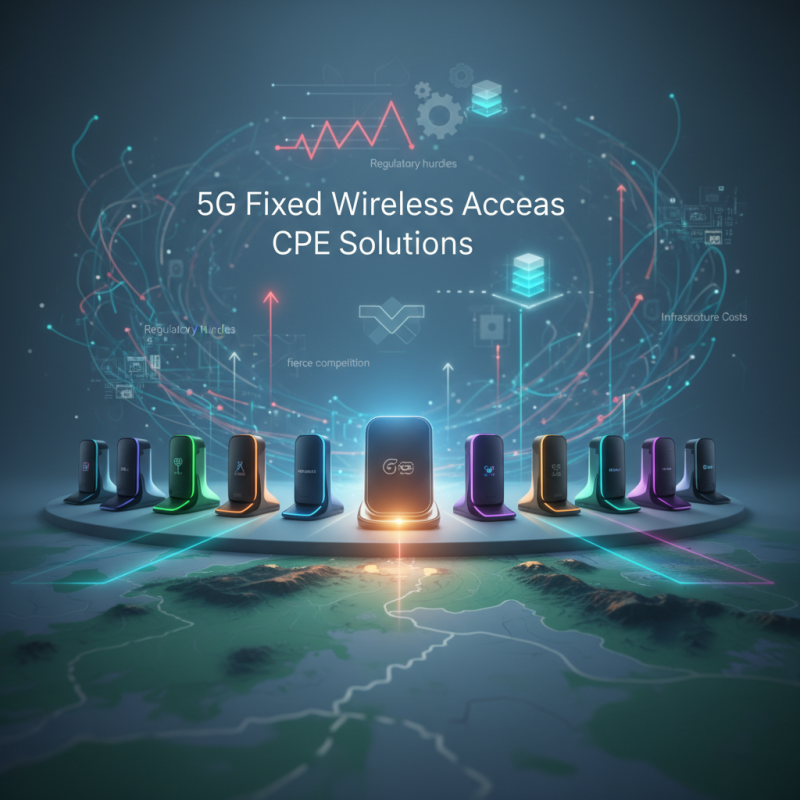
Companies must navigate obstacles like infrastructure costs and regulatory hurdles. The competition is fierce, and not all solutions are created equal. Evaluating the top 10 offerings requires a discerning eye. Each solution comes with unique strengths and weaknesses. Recognizing these intricacies is essential for making informed decisions in this dynamic market.
Overview of 5G Fixed Wireless Access Technology
5G Fixed Wireless Access (FWA) represents a significant step in telecommunications technology. This innovation utilizes high-frequency radio signals to deliver internet connectivity. Unlike traditional wired connections, FWA can reach remote regions swiftly and efficiently. It offers flexibility and scalability, making it ideal for urban and rural deployments alike.
The technology operates through a network of base stations that connect to customer premise equipment (CPE). These CPE devices can range from indoor routers to outdoor antennas. The setup is less invasive compared to fiber-optic installations. Yet, it can sometimes face challenges, such as signal interference and varying performance based on environmental conditions. Users may find some setups require more engineering to optimize their connections, reflecting the technology's current evolution.
Understanding the role of 5G FWA is crucial for anyone interested in future connectivity. It provides potential solutions for underserved areas. However, not all regions will experience the same benefits. Infrastructure and geographical factors can play significant roles in determining performance. As this technology advances, its effectiveness will continue to improve, but challenges remain.
Key Features of CPE Solutions for 5G Connectivity
As 5G technology continues to evolve, the demand for effective fixed wireless access (FWA) solutions grows. A critical aspect of these solutions lies in the Customer Premises Equipment (CPE). Key features include robust performance, ease of installation, and seamless connectivity. Industry reports indicate that 61% of users prioritize signal strength and reliability when selecting CPE solutions. This emphasis on performance directly impacts user experience.
Another important feature is compatibility with existing networks. Many CPE devices can work across various frequency bands, making them versatile. According to research, nearly 75% of network operators look for devices that provide backward compatibility with 4G LTE. This ensures users can access high-speed internet without significant disruptions during network transitions.
Security also plays a crucial role. Many users remain concerned about data privacy and protection. Reports show that 58% of consumers express apprehension regarding cybersecurity. Thus, CPE solutions must offer advanced security features, such as encryption and firewall protection, to build trust among users. Nevertheless, some CPE devices still lack adequate security measures. This gap serves as a reminder for manufacturers to prioritize user safety.
Top 10 5G Fixed Wireless Access CPE Solutions You Must Know
| Solution Name | Max Download Speed | Max Upload Speed | Coverage Area | Key Features |
| Solution A | 1 Gbps | 500 Mbps | Up to 5 km | Plug-and-play, Dual-band support |
| Solution B | 800 Mbps | 300 Mbps | 3 km | MIMO technology, Secure VPN |
| Solution C | 1.5 Gbps | 700 Mbps | 6 km | Low latency, Easy installation |
| Solution D | 500 Mbps | 200 Mbps | 2 km | Advanced security, Flexible setup |
| Solution E | 1.2 Gbps | 600 Mbps | 4 km | Mesh support, User-friendly interface |
| Solution F | 700 Mbps | 350 Mbps | 3.5 km | Ethernet backhaul, Quality of Service (QoS) |
| Solution G | 900 Mbps | 400 Mbps | 5 km | High bandwidth aggregation, Remote management |
| Solution H | 1 Gbps | 500 Mbps | 3 km | Smart antenna, Auto update features |
| Solution I | 1.2 Gbps | 550 Mbps | 4 km | User prioritization, Advanced firewall |
| Solution J | 600 Mbps | 250 Mbps | 2.5 km | Multiple device support, Customizable settings |
Top 10 5G CPE Solutions: A Comparative Analysis
In recent years, 5G technology has transformed fixed wireless access solutions. As they gain popularity, understanding their capabilities becomes crucial. A comparative analysis of 5G CPE solutions reveals varying performance metrics, pricing models, and user experiences. Factors such as signal strength and ease of installation play a vital role in customer satisfaction.
Tips: When choosing a 5G CPE solution, evaluate the coverage areas. Not all devices perform equally well in every location. Some users have reported weak signals in urban environments. Test different devices in your area before making a permanent choice.
Another aspect to consider is future-proofing your investment. 5G technology is rapidly evolving, and compatibility with future upgrades is essential. Some devices may lack the ability to adapt to newer standards. Users should always inquire about potential firmware updates from providers. This way, you can avoid falling behind as technology progresses.
Top 10 5G Fixed Wireless Access CPE Solutions - Performance Comparison
Factors to Consider When Choosing a 5G CPE Solution
When considering a 5G CPE solution, several factors must be evaluated. The first is performance. A recent study by the Global Mobile Suppliers Association revealed that 5G networks can achieve speeds up to 10 Gbps. However, real-world speeds may vary based on location and network congestion. Prospective users should prioritize solutions that demonstrate consistent, high-speed capabilities under various conditions.
Next is compatibility with existing infrastructure. It's essential to ensure that the chosen CPE can work seamlessly with current devices and networks. A survey by Ericsson indicated that 71% of telecom operators are actively investing in network upgrades. This signals a shift towards more integrated solutions, which demand compatible CPE technology. Adaptability is crucial. Diverging standards in 5G technology might lead to future obsolescence if one doesn't choose wisely.
Lastly, installation and user experience matter. Reports show that nearly 60% of users find complex setup processes frustrating. Solutions should offer intuitive interfaces and clear guidance. Moreover, customer support services play a vital role. In an industry where user trust is paramount, effective assistance can distinguish a reliable solution from a mediocre one. As 5G continues to evolve, prospective users should remain vigilant about ongoing developments and adjustments in technology.
Future Trends in 5G Fixed Wireless Access Solutions
The rapid evolution of 5G fixed wireless access (FWA) solutions is reshaping connectivity. More users demand reliable internet access, and 5G technology delivers it seamlessly. One trend emerges: the increasing reliance on millimeter-wave frequencies. This enables faster speeds but requires careful infrastructure planning. Network providers must consider geographic and environmental challenges when rolling out these solutions.
Another significant trend is the deployment of advanced antenna technologies. Beamforming and massive MIMO (Multiple Input Multiple Output) are enhancing signal strength and coverage. These technologies help mitigate interference, leading to improved user experiences. However, achieving optimal performance can be complex. Providers must continually adapt their strategies based on user feedback and network performance data.
Moreover, the integration of AI and machine learning will play a critical role in managing networks. By analyzing traffic patterns, these technologies can optimize resource allocation. The future holds promise, but there are hurdles. Compatibility issues, regulation changes, and evolving customer expectations pose challenges. Continuous assessment and flexibility will be vital for the success of 5G FWA solutions.