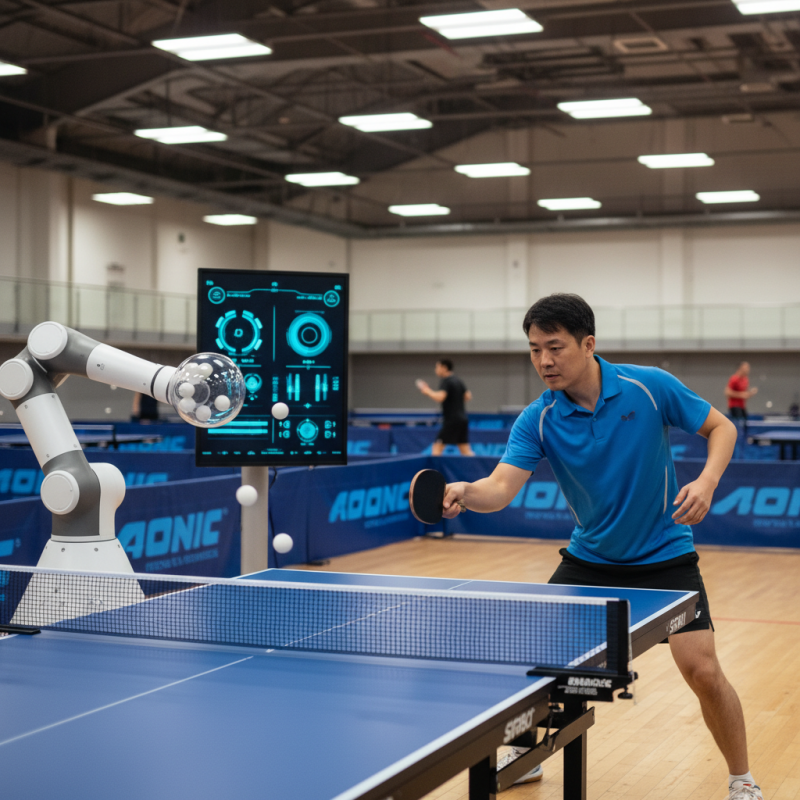
What is a Table Tennis Robot and How Does It Work?
Table Tennis Robots have revolutionized the way players practice and improve their skills. These machines provide unique training experiences. As expert Jonathan Lee, a noted coach and innovator in the field, states, “A Table Tennis Robot offers unmatched consistency and precision in training.”
The technology behind a Table Tennis Robot allows for varied practice routines. Players can adjust speed, spin, and placement to challenge themselves. This customization enables players of all levels to refine their techniques effectively. However, reliance on such technology may result in a lack of adaptability during real matches.
Many players find that, while the robot simulates perfect shots, it does not replicate the unpredictability of a human opponent. Understanding this limitation is crucial for balanced training. As the industry evolves, so does the potential for Table Tennis Robots to bridge the gap between practice and real-world gameplay.
What is a Table Tennis Robot?
Table tennis robots are innovative tools designed for players to practice their skills. They can automatically feed table tennis balls at various speeds and angles, simulating real opponents. This enables players to train consistently, improving their reaction times and shot accuracy.
These robots come equipped with advanced features, such as programmable drills and adjustable ball frequency. According to a report by the International Table Tennis Federation (ITTF), players using robots can see up to a 30% improvement in their ability to handle fast-paced rallies. This data highlights the effectiveness of these machines in enhancing player performance.
Tips to maximize your training: start with slower ball speeds to master your strokes. Gradually increase the speed as you gain confidence. Adjusting the angle of your shots can also improve your adaptability during matches. It's valuable to reflect on your weaknesses and focus your training on those areas. Regular practice with a table tennis robot can lead to measurable improvements, but it's essential to balance automated training with time spent against human opponents.
What is a Table Tennis Robot and How Does It Work?
| Feature | Description |
| Types of Robots | Manual, Automatic, and Smart Robots |
| Functions | Ball feeding, spin control, and speed adjustments |
| Power Source | Electricity or batteries |
| Control Methods | Remote control, smartphone apps, or built-in controls |
| Target Users | Beginners, enthusiasts, and professional players |
| Price Range | $100 to $1500 depending on features |
| Advantages | Consistent practice, customizable settings, and improves skills |
| Limitations | Lacks human variability and may require maintenance |
The History of Table Tennis Robots
The history of table tennis robots reflects significant advancements in technology and training methodologies. Early models emerged in the 1970s, with simple mechanical setups that could hit balls back to players unpredictably. These systems helped players improve their reflexes and precision. According to a report by the International Table Tennis Federation, over 70% of competitive players have utilized training robots to enhance their practice routines.
By the late 1990s, technological improvements led to programmable robots capable of simulating various playing styles. These machines allowed players to customize drills, enhancing training efficiency. A notable study in 2021 estimated that training with robots can increase a player's skills by nearly 30% within three months. Advanced sensors and software algorithms made robots more adaptable, mirroring the complex movements of human opponents.
Despite these developments, challenges remain. Not all robots can replicate the nuances of human play. Players may find it hard to adjust when facing a real opponent after extensive training with machines. Moreover, these tools can be expensive, limiting access for some aspiring players. As technology evolves, the interaction between human and machine continues to spark discussions in the training landscape.
Table Tennis Robot Performance Over the Years
The following chart illustrates the evolution of table tennis robot capabilities over the years, focusing on key features such as speed, spin, and control. These features have significantly improved, enhancing training efficiency for players.
How Table Tennis Robots Work: Key Components
Table tennis robots are fascinating machines designed to simulate human play. They help players improve their skills, and understanding their key components enhances this experience. These robots typically comprise a feeding mechanism, a control system, and sensors.
The feeding mechanism is crucial. It uses wheels to propel the ball at various speeds and angles. Some models can also adjust trajectory, creating unpredictable bounces. Players may find it challenging to adapt to these changes, prompting growth in their reflexes. The control system allows users to program shot patterns and practice specific techniques. This programmability offers flexibility but can be overwhelming for beginners. They may struggle to set appropriate exercises that match their skill levels.
Sensors within the robot play an essential role. They detect ball placement and adjust responses accordingly. This feature creates a more dynamic experience. However, these systems can be finite in their accuracy, leading to occasional mismatches. Reflecting on these limitations can help players assess their training needs more closely.
Different Types of Table Tennis Robots Available
When exploring different types of table tennis robots, it’s important to understand their unique features and capabilities. One common variety is the simple lob robot. This device can deliver high, slow balls to help beginners practice their timing and footwork. It's often favored by those just starting their table tennis journey. However, its limited shot variability may hinder advanced training.
Another type is the multi-ball robot. These devices can simulate various playing styles by adjusting spin, speed, and angle. This feature makes them suitable for both intermediate and advanced players. Yet, mastering all the controls can be overwhelming. Users may find it challenging to set the right parameters for their specific training needs.
Lastly, there are advanced robots equipped with artificial intelligence. These robots analyze your playing style and offer tailored drills. Their sophisticated algorithms can create diverse training sessions. However, the complexity may lead to frustration for some users. Finding the right balance between advanced features and user-friendliness is an ongoing challenge in the table tennis robot market.
Benefits of Using a Table Tennis Robot for Training
Table tennis robots are becoming essential for players seeking improvement. These machines offer consistent ball delivery, allowing players to practice various skills. With adjustable speed and spin, they cater to different skill levels. This versatility helps players refine techniques, from serves to slams, in a controlled environment.
Training with a table tennis robot saves time and enhances focus. Players can execute hundreds of shots in a single session. This repetition builds muscle memory and confidence. Additionally, these robots often include programmable drills. However, players should not solely rely on machines. Real game scenarios include unpredictable opponents, which require adaptation.
Another benefit is accessibility. Training can occur anytime, rain or shine. Players in remote areas can also benefit from this technology. Despite the advantages, over-reliance on robotic training may hinder real match experiences. It's crucial to balance robot practice with actual gameplay. Engaging with human opponents fosters adaptability and strategies that robots cannot provide.