What is Ncr Carbonless Paper and How Does It Work?
Ncr Carbonless Paper has revolutionized the printing industry since its invention. This innovative paper allows for easy duplication without the need for carbon sheets. According to a recent report by Smith & Associates, the demand for Ncr Carbonless Paper has increased by 30% over the past five years, indicating its significant role in modern business practices.
Industry expert Dr. Alice Whitney remarked, "Ncr Carbonless Paper simplifies documentation while enhancing efficiency." Her insights highlight the paper's ability to streamline processes in various sectors, from logistics to finance. However, awareness about its environmental impact remains essential.
While Ncr Carbonless Paper is more convenient, manufacturers must address sustainability challenges. The production process can involve chemicals that raise concerns among eco-conscious consumers. As the industry grows, balancing efficiency with eco-friendliness will be vital for future developments.
What is NCR Carbonless Paper?
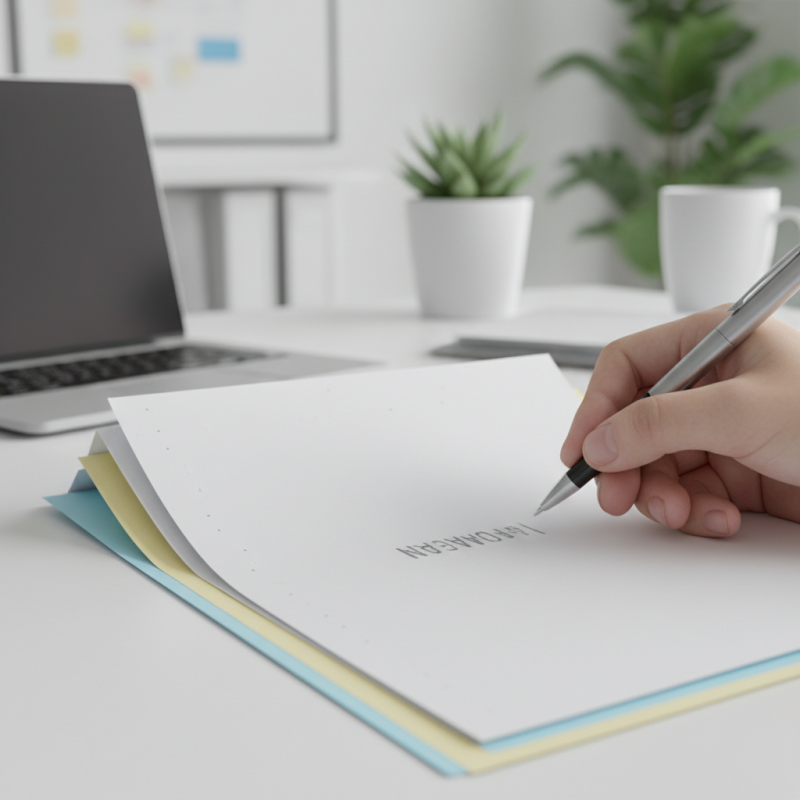
NCR carbonless paper is a unique type of paper used for creating duplicate or triplicate documents without the need for carbon paper. It contains special coatings on the back of the top sheets and the front of the subsequent sheets. When pressure is applied, such as when writing or typing, the coating transfers the impression to the sheets below. This process allows for multiple copies of a document to be created simultaneously.
The versatility of NCR paper makes it popular in various industries. Businesses use it for invoices, purchase orders, and receipts. Typically, the top sheet is white, with subsequent sheets in different colors. This color differentiation helps in identifying copies easily. Each layer serves a specific purpose, ensuring clarity in communication. Sometimes, the transfer isn't perfect. Ink smudges might appear, or the copies may be too faint. Users often must redo documents, leading to frustration.
Understanding how NCR paper works can simplify record-keeping. Each copy serves its purpose but requires accuracy. It's essential to apply consistent pressure to ensure clear transfer. Users may find themselves questioning the reliability of the copies. The learning curve can be steep. However, when used correctly, NCR carbonless paper can streamline operations significantly.
Historical Development of NCR Carbonless Paper
NCR carbonless paper has a fascinating history. It was invented in the 1950s as a solution to the inconvenience of carbon paper. Traditional carbon paper was messy and often left smudges on documents. The idea was to create a clean way to make duplicates. The first successful development involved a process using micro-encapsulated dye. This innovation changed the way copies were made.
This paper quickly gained popularity in various industries. Businesses began to see the value of quick, efficient copying. This method simplified paperwork without the usual complications. Over time, NCR carbonless paper evolved. New formulations made it more versatile. It became suitable for multiple uses, including invoices and receipts.
Yet, despite its convenience, it wasn't perfect. Some early users experienced issues with poor prints or fading. These challenges led to further research and improvements in the design. The journey of NCR carbonless paper reflects a blend of innovation and the need for continuous improvement.
How NCR Carbonless Paper Functions Mechanically
NCR carbonless paper plays a unique role in the printing world. It is designed for creating multiple copies of documents without the need for carbon paper. The magic occurs through a simple, yet effective mechanism. Each sheet is coated with a micro-encapsulated dye on the top and a clay coating on the bottom. When pressure is applied, like when writing or typing, the micro-capsules burst. This releases the dye onto the next sheet, producing a clear copy below.
The mechanical function of NCR paper is fascinating but can lead to errors. If the pressure is too light, the dye may not transfer properly. This can result in faint copies that are hard to read. When using it, you may notice some variation in the clarity of the copies. Factors like humidity and temperature can negatively impact its performance. Users sometimes struggle with understanding the ideal conditions for optimal results.
In conclusion, while NCR carbonless paper is innovative, it requires careful handling. Learning the subtleties of how it works can take time. Not every attempt yields flawless results. Understanding these nuances can enhance the user experience, but mistakes are also part of the journey.
Different Types and Uses of NCR Carbonless Paper
NCR carbonless paper has become essential in various industries. Its unique design allows for multiple copies without using carbon paper. The most common types are two-part and three-part forms. Two-part forms create one original and one copy, while three-part forms produce an additional duplicate.
Businesses often use NCR paper for invoices, receipts, and purchase orders. Each layer transfers information from the top sheet to the underlying ones. This saves time and ensures accuracy. Small businesses love it for simplifying record-keeping.
Here’s a tip: choose the right weight for your needs. Thicker paper is often more durable but may not be necessary for short-term use. Also, consider color coding. Different colors can help organize files better.
Another tip: test different printers. Some printers handle NCR paper better than others, affecting print quality and clarity. Always experiment to find the best resolution.
Benefits of Using NCR Carbonless Paper in Various Industries
NCR carbonless paper is a unique type of paper designed to create copies without using carbon sheets. Its special coating allows for the transfer of information from the top sheet onto the sheets below. This process makes it ideal for businesses that require multiple copies of documents. The print looks neat and clear, which often helps in maintaining professional standards.
Many industries benefit from using NCR carbonless paper. For instance, in retail, it streamlines invoicing and receipt generation. Business transactions get recorded quickly. In healthcare, it’s used for patient records and prescriptions, ensuring that essential information is readily available. However, some users report challenges with legibility when too many copies are made at once.
While NCR paper is efficient, it might not work for every situation. Some businesses find it hard to store large volumes of such paper. Others worry about the environmental impact of disposable products. It’s important to weigh these aspects carefully. Evaluating whether to switch to this paper requires considering both benefits and drawbacks.