
How to Choose String Wound Filter Cartridges in 2026?
Choosing String Wound Filter Cartridges in 2026 requires more than comparing micron ratings and prices. Industrial liquids are becoming more diverse, while equipment operates under tighter efficiency and maintenance targets. Water treatment, chemical processing, food production, and manufacturing systems may all need different filtration strategies. A cartridge that performs well in clear water may fail quickly in viscous oil. Small details matter.
This guide explains how to evaluate cartridge material, winding density, pore structure, length, diameter, and end-cap design. It also considers flow rate, pressure drop, temperature, chemical compatibility, and dirt-holding capacity. Experienced technicians often inspect the liquid before selecting a cartridge. They check suspended solids, viscosity, operating temperature, and cleaning requirements. A nominal rating is not the same as an absolute rating. That difference can affect downstream protection.
Reliable decisions should use current manufacturer datasheets, test results, and application records. Field experience helps, but it can also create bias. I have seen teams reuse a familiar cartridge without checking changed process conditions. That shortcut sometimes increased replacement frequency and energy use. No selection method is perfect.
The most practical approach combines laboratory information with real operating evidence. Monitor differential pressure, flow stability, and contaminant loading after installation. Keep records from each replacement cycle. These details reveal whether the chosen cartridge is genuinely suitable. Product claims deserve careful review. Independent testing may still be limited for unusual liquids. This article offers a professional framework, but final verification should involve qualified filtration specialists and the equipment manufacturer.
Understanding String Wound Filter Cartridges and Their Filtration Principles
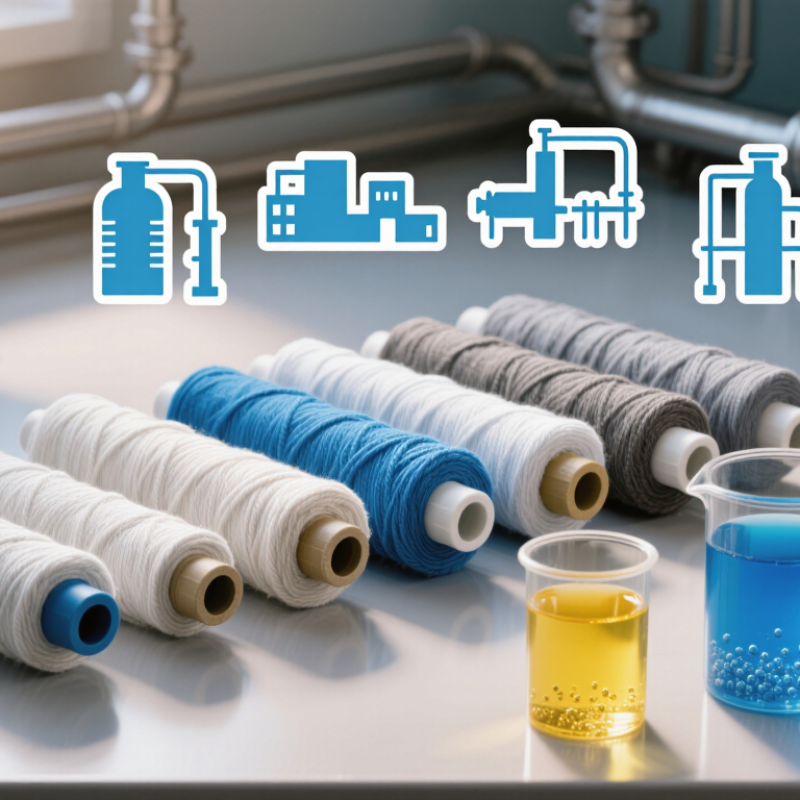
String wound filter cartridges use a yarn wrapped around a central core. The winding pattern creates layers with different pore paths. Outer layers are often more open, while inner layers become tighter. As liquid flows through the cartridge, larger particles are trapped first. Smaller particles move deeper into the media. This is depth filtration, not simple surface screening. In practical use, I have found that this structure handles particles across a wider range than a single thin membrane.
Choose the cartridge according to the fluid, not only the advertised micron rating. A nominal rating and an absolute rating can describe very different retention performance. Check viscosity, temperature, chemical compatibility, flow rate, and acceptable pressure loss. Do not trust the micron number alone. A highly viscous liquid may need a larger cartridge or slower flow. Confirm the housing size, end connection, and core material before ordering. Small mismatches create expensive delays.
During testing, record inlet pressure, outlet pressure, flow, and replacement time. A cartridge that lasts longer may still waste energy through high pressure drop. If pressure rises quickly, inspect for heavy loading, unsuitable media, or uneven flow. Keep the test fluid consistent when comparing options. The data may disagree. That is normal. Laboratory ratings do not always match field conditions, and my own early selections were sometimes too optimistic. Reliable decisions come from datasheets, test certificates, and real operating records rather than one impressive specification.
How to Choose String Wound Filter Cartridges in 2026? - Understanding String Wound Filter Cartridges and Their Filtration Principles
Use this comparison guide to match cartridge construction, nominal micron rating, fluid conditions, and operating requirements with the intended filtration duty.
| Selection Dimension | Typical Options or Range | Filtration Principle | Best-Fit Applications | Key Selection Considerations |
|---|---|---|---|---|
| Cartridge Construction | Continuous yarn wound around a rigid or perforated core | Particles are retained both at the surface and within the depth of the yarn structure. | Pre-filtration, process-water treatment, irrigation water, cooling water, and general industrial liquid filtration | Depth loading provides useful dirt-holding capacity, but the cartridge should be replaced when pressure drop reaches the equipment limit. |
| Nominal Micron Rating | Commonly available from approximately 1 to 100 µm | A nominal rating indicates that the cartridge removes a stated percentage of particles at or above a specified size under defined test conditions. | General clarification and protection of downstream equipment | Nominal ratings are not equivalent to absolute ratings. Confirm the test method and removal efficiency before selecting a cartridge for critical applications. |
| Fine Filtration | Approximately 1–10 µm nominal | The tighter yarn structure creates smaller flow paths and increases particle interception. | Fine sediment reduction, polishing before membrane systems, and protection of sensitive components | Provides finer particle removal but normally causes a faster pressure-drop increase when the feed contains a high solids load. |
| Medium Filtration | Approximately 10–25 µm nominal | Balances depth loading capacity with moderate particle retention. | Municipal or well-water pre-filtration, industrial process water, and general utility-water treatment | Often a practical starting range when the feed-water particle distribution is not fully characterized. |
| Coarse Filtration | Approximately 25–100 µm nominal | Larger flow passages capture coarse suspended solids while reducing the risk of rapid blinding. | Sand, rust, scale, and other relatively coarse particles; upstream protection for finer filters | Use a staged design when both high solids loading and fine downstream protection are required. |
| Yarn Material: Polypropylene | Common choice for aqueous and many general industrial services | Polypropylene yarn forms a chemically resistant depth medium with low moisture absorption. | Water, dilute acids, dilute alkalis, and many inorganic process liquids | Check the exact chemical concentration and temperature. Compatibility can change significantly with oxidizing chemicals and organic solvents. |
| Yarn Material: Polyester | Used where higher mechanical strength and broader temperature capability than some general-purpose fibers are needed | Polyester yarn provides depth filtration with good dimensional stability. | Industrial water and selected oil-based or chemical services | Verify compatibility with strong alkalis, concentrated acids, and specific solvents before use. |
| Yarn Material: Cotton | Natural-fiber option for selected low-temperature services | Cotton yarn captures particles through a relatively compressible, absorbent depth structure. | Some non-critical water and compatible liquid applications | Higher moisture absorption and biological sensitivity can limit use. Confirm cleanliness, extractables, and chemical compatibility. |
| Yarn Material: Fiberglass | Available for selected high-temperature or chemically demanding applications | Fine inorganic fibers create a rigid depth-filtration matrix. | Specific industrial liquids and applications requiring low organic-fiber contribution | Check fiber shedding controls, handling requirements, and compatibility with the process fluid. |
| Common Cartridge Lengths | 10, 20, 30, and 40 inches are common nominal lengths | Longer cartridges provide more effective filtration area and greater dirt-holding volume when installed in a compatible housing. | Small point-of-use systems through larger industrial housings | Match the length, end configuration, core diameter, and sealing arrangement to the filter housing. |
| Flow Direction | Typically outside-to-inside, depending on the housing design | Contaminated liquid passes through the outer yarn layers and exits through the central core. | Standard cartridge-Filter Housings designed for external loading | Always follow the housing flow-path specification. Reverse flow can dislodge captured solids or damage the cartridge. |
| Pressure-Drop Monitoring | Use the initial clean pressure drop as the operating baseline | As particles accumulate in the depth medium, resistance to flow increases. | All applications where consistent flow and downstream protection are important | Replace or service the cartridge according to the housing manufacturer's differential-pressure limit, not solely by calendar time. |
| Temperature Selection | Depends on yarn, core, seals, fluid chemistry, and pressure | Temperature affects polymer strength, chemical compatibility, viscosity, and pressure-drop behavior. | Ambient-temperature water through selected heated process liquids | Do not rely on a generic maximum temperature. Confirm the complete cartridge assembly rating for the actual fluid and operating pressure. |
| Chemical Compatibility | Evaluate yarn, core, end caps, gaskets, and any bonding materials together | Filtration performance can remain stable while materials swell, soften, embrittle, or extract into the fluid. | Acids, alkalis, solvents, oils, and specialty process liquids | Review concentration, temperature, exposure time, and cleaning chemicals. A compatibility chart or immersion test may be required. |
| When to Use a Staged System | Coarse cartridge upstream followed by a finer cartridge | The first stage removes larger solids and reduces the loading rate on the finer second stage. | High-turbidity water and processes with a wide particle-size distribution | Staging usually improves service life and can reduce the total operating cost compared with using a fine cartridge alone. |
| Final Decision Checklist | Fluid, flow rate, particle size, solids loading, temperature, pressure, chemistry, length, end type, and seal material | Correct selection depends on the interaction of removal target, hydraulic capacity, material compatibility, and housing fit. | Any liquid-filtration application requiring a replaceable depth cartridge | Choose the lowest practical micron rating that meets the process objective without creating excessive pressure drop or premature blockage. |