
China Best Industrial Panel PC Supplier?

Choosing China’s best supplier of an Industrial Panel Pc takes more than comparing prices or product photos. Buyers need to examine the details that shape daily performance: processor options, display brightness, touch response, operating-temperature range, and long-term parts availability. A unit beside a packaging line may face vibration, dust, and repeated glove use. A system monitoring a clean production room may need different protection and connectivity. Small details matter.

An illustrative expert viewpoint—not a verified quotation—captures the central question: “A panel PC earns trust when its specifications match the real conditions on the factory floor.” The fictional specialist, Alex Morgan, represents the engineering perspective used in this guide. Supplier claims still need checking against product datasheets, test reports, warranty terms, and actual project references. Marketing language alone is not proof.

This outline will compare suppliers through practical criteria: product range, customization, certifications, quality controls, technical support, and delivery consistency. It will also consider questions buyers should ask before requesting a quotation, such as how a supplier validates touchscreens and handles replacement parts. No supplier is ideal for every installation. A low-cost model can become expensive if repairs interrupt production; a premium unit may offer features a project never uses. The aim is a careful shortlist, not a sales pitch. A little skepticism helps.
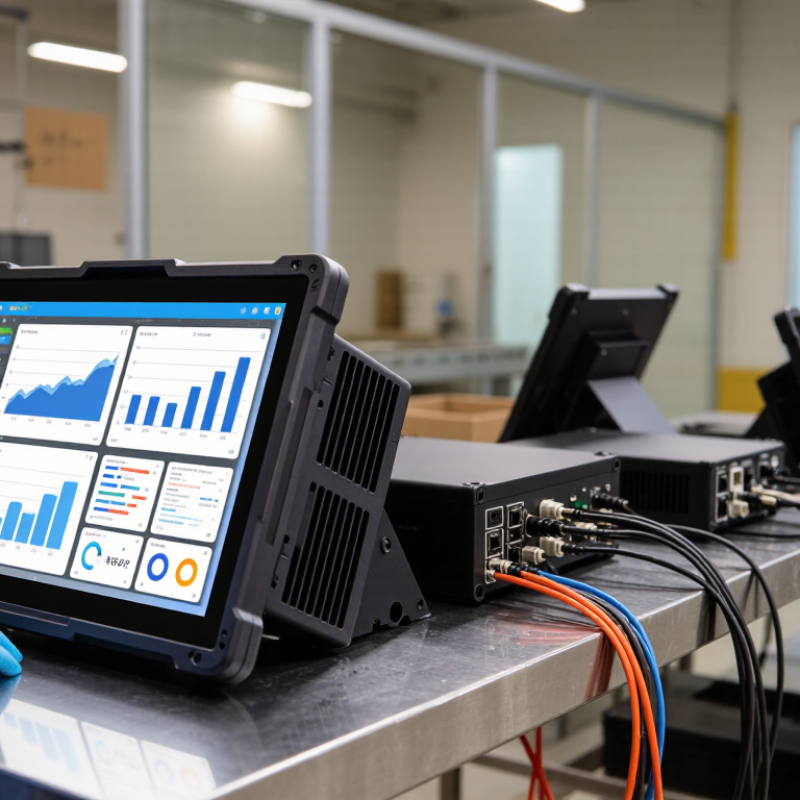
China Best Industrial Panel PC Supplier?

What Is an Industrial Panel PC and Where Is It Used?

An industrial panel PC combines a computer and a touchscreen in one unit, usually mounted in a control cabinet, machine, or operator station. Its display lets workers view production data, enter settings, and interact with control software near the process. Unlike an ordinary office computer, it is designed for demanding environments, with features such as a sturdy enclosure, a wide operating temperature range, and resistance to vibration. The exact protection varies. A sealed front does not automatically mean the entire unit can withstand water or fine dust. Dust gets everywhere.

Heat is relentless.

These computers are used on factory lines, packaging equipment, warehouse stations, and process-control panels. An operator might use one to check a conveyor’s status, adjust a permitted production setting, or review an alarm without walking to a separate workstation. Before choosing a unit, engineers typically consider screen size, touch response with gloves, mounting space, available ports, and the software it must run. They also check how the enclosure handles the site’s actual temperature, moisture, and cleaning routine.

It is easy to focus on processor speed and miss the small details, such as glare from overhead lights or a cable that blocks access to a cabinet door. Those details deserve a second look.

How China’s Industrial Panel PC Supplier Market Is Structured

China’s industrial panel PC supplier market is a layered ecosystem, not a single factory category. It includes in-house manufacturers, design-and-manufacturing contractors, embedded-computing specialists, and regional system integrators. Some suppliers build the computer and display; others combine sourced components into a configured unit. Their products may look similar, but operating temperature, touch response, mounting options, and interface support can differ.

Demand is tied to automation across factories and logistics sites. The International Federation of Robotics reported 276,288 industrial robots installed in China in 2023, representing 51% of global installations. This indicates a substantial automation base, but it is not a panel PC sales figure. Buyers should compare suppliers on application testing, supply continuity, and documented product life cycles—not just unit price. A bright screen under factory lighting matters. So does a connector that stays secure through vibration.

Supplier roles can overlap, which makes simple labels unreliable. A trading company may coordinate customization, while the actual engineering and assembly happen elsewhere. Ask who validates thermal performance, maintains drawings, and handles replacement units. One weakness in many sourcing decisions is treating a sample as proof of long-term reliability. It isn’t. Independent market reports rarely disclose China-specific supplier counts, so claims of market leadership deserve careful verification.

Which Standards Define a Reliable Panel PC Supplier?

A reliable industrial panel PC supplier should prove performance through documented controls, not polished claims. ISO 9001:2015 defines requirements for a quality management system, including controlled processes and continual improvement. The ISO Survey 2022 recorded 1,265,216 valid ISO 9001 certificates worldwide. That figure shows how widely the standard is used; it does not prove that a specific panel PC will survive your factory.

Check whether the supplier can provide traceable test reports and clear acceptance criteria. IEC 62368-1 may apply to equipment within its scope, while IEC 61000-4-2 describes immunity testing for electrostatic discharge. Ask for results relevant to your operating conditions: temperature range, vibration, dust exposure, and touchscreen use with gloves. A certificate alone is not enough. Inspect the test setup, sample configuration, and report date. Paperwork can still miss real-world details.

Tips: Request a sample unit and run it beside your production line. Check the screen after repeated glove touches, inspect connectors after vibration, and confirm how replacement parts are tracked. A short trial can reveal gaps that a tidy certificate cannot.

How to Compare Chinese Suppliers by Product and Service

Comparing Chinese industrial panel PC suppliers starts with the machine, not the quotation. Match screen size, brightness, touch type, processor, memory, storage, and operating temperature to the actual installation. A 15-inch screen may look adequate in an office, yet become hard to read beside a sunlit production line. Ask for drawings, interface lists, and test records for the exact configuration. Generic catalog specifications are not enough.

Market demand offers context, not proof of supplier quality. Grand View Research estimated the global industrial PC market at USD 5.19 billion in 2023, with a projected 7.4% annual growth rate through 2030. These are market estimates, and forecasts can change. Use them to understand the sector’s direction—not to assume every supplier has mature engineering. Request evidence of burn-in testing, vibration checks, and sample performance under your site’s temperature range.

Service deserves the same scrutiny as hardware. Ask how quickly the supplier answers technical questions, handles a failed unit, and supplies replacement parts. Get warranty terms, repair lead times, and software support in writing. A live video inspection of the assembly line can clarify more than a polished brochure. Small details matter. I would still test a sample for several weeks; a neat specification sheet can miss awkward mounting, cable access, or touch response with gloves.

China Best Industrial Panel PC Supplier? - How to Compare Chinese Suppliers by Product and Service

Category Comparison Dimension What to Compare Evidence to Request Supplier 1 Supplier 2 Supplier 3
Product Display and touch options Check available screen sizes, resolution, brightness, viewing angle, touch technology, and whether the offered configuration fits the installation environment. Model-specific datasheet and configuration list — — —
Product Processor, memory, and storage Compare processor model, RAM and storage type/capacity against the actual workload. Confirm whether the quoted components are standard or optional. Bill of materials or written configuration confirmation — — —
Product Operating environment Compare the specified operating-temperature and humidity ranges with site conditions. Confirm whether the limits apply to the complete unit and selected configuration. Datasheet and test conditions for the quoted model — — —
Product Ingress protection and enclosure Compare the stated IP rating for the exact enclosure and mounting method. An IP rating describes protection against dust and water under specified test conditions; it does not by itself establish resistance to chemicals or impact. Test report or certificate identifying the tested model and configuration — — —
Product I/O and connectivity Verify the number and type of required ports, such as Ethernet, USB, serial, and display interfaces. Check connector placement and any optional fieldbus or wireless modules. Port diagram and model-specific I/O specification — — —
Product Power and mounting compatibility Check input-voltage range, power connector, power consumption, mounting dimensions, cutout size, and supplied mounting accessories against the installation plan. Mechanical drawing, power specification, and installation guide — — —
Product Compliance and EMC Confirm which regulatory requirements apply in the destination market and whether the exact model and configuration have supporting documentation. Requirements vary by product and market. Applicable declarations, test reports, and certificate details — — —
Product Customization and product lifecycle Compare available changes to I/O, enclosure, branding, or BIOS settings, along with engineering fees, minimum order quantities, revision control, and component-change notification practices. Written customization scope and change-control policy — — —
Service Sample and validation support Compare sample availability, sample cost, configuration accuracy, and support for testing with the intended software, peripherals, and operating conditions. Sample quotation and agreed validation checklist — — —
Service Quality assurance and traceability Ask how incoming inspection, production testing, serial-number tracking, and defect handling are managed. Compare the documented process rather than relying on general quality claims. Inspection checklist, sample test record, and quality procedure summary — — —
Service Warranty and repair process Compare warranty duration, coverage exclusions, return procedure, repair location, and responsibility for shipping costs. Confirm the terms in the quotation or sales contract. Written warranty terms and RMA procedure — — —
Service Technical communication and documentation Assess response clarity, technical availability, time-zone coverage, and the completeness of manuals, drivers, BIOS information, and troubleshooting instructions. Document samples and agreed support contact or response process — — —
Service Lead time and order terms Compare quoted lead time for samples and production, minimum order quantities, payment terms, packaging, shipping options, and how schedule changes are communicated. Itemized quotation and written delivery schedule — — —
Overall Total cost and fit Compare the complete delivered configuration, including accessories, customization, shipping, duties, and expected support needs. Select against the application requirements, not unit price alone. Comparable itemized quotations and completed requirement checklist — — —

Suggested scoring: 1 = does not meet requirements; 3 = meets requirements with conditions; 5 = meets requirements with clear supporting evidence. Use “N/A” where a criterion does not apply.

How to Verify a Supplier Before Placing an Order

China Best Industrial Panel PC Supplier?

How to Verify a Supplier Before Placing an Order

Choosing a supplier takes more than comparing prices and polished product photos. Ask for a current datasheet that lists screen size, brightness, processor, memory, operating temperature, and ingress protection rating. Check that the offered configuration matches your actual installation, including mounting points and available ports. Request a sample unit and run it with your software and peripherals. Watch for touch lag, uneven backlighting, loose connectors, and heat buildup after several hours. Small details matter. A neat PDF is not proof of production capability. Ask for a live factory walkthrough or a recent quality-control report, and confirm that the documents match the exact model you plan to buy.

Tips: Verify certifications with the issuing organization and check their scope and expiry date. Ask for a written warranty, spare-parts policy, and clear lead time. Compare the sample with the final quotation.

Before paying a deposit, agree on inspection criteria, packaging, delivery terms, and what happens if units fail testing. Request references from customers using similar panel PCs in comparable environments. A supplier may answer quickly but still overlook a detail; I would clarify ambiguous specifications in writing, even if it feels repetitive. Keep the approved sample and signed configuration sheet for comparison when the shipment arrives.

CONTACT US