
7 Best Threaded Linear Shafts for Global Buyers?

Choosing the right Threaded Linear Shaft can determine whether a machine moves smoothly or develops costly alignment problems. Global buyers face different loads, travel lengths, temperatures, coatings, and delivery conditions. A shaft that performs well in a clean laboratory may fail in a dusty packaging line. Context matters.

This guide examines seven strong options for international applications. Each choice should be judged by thread accuracy, shaft straightness, material hardness, surface finish, corrosion resistance, and available technical documentation. Check load ratings carefully. Confirm the nut, support bearings, and mounting method as one system. Do not evaluate the shaft alone.

Dr. Alexander H. Slocum, a respected precision-machine designer, wrote, “The design of a machine is the embodiment of a set of compromises.” That principle applies directly here. Higher hardness may improve wear resistance, yet it can increase cost or complicate machining. Stainless steel may suit humid environments, but it does not automatically solve every corrosion concern. Small details matter.

Real purchasing experience also exposes less obvious risks. Thread standards may differ between suppliers. Packaging can affect surface quality during long-distance shipping. Some product pages provide attractive specifications but limited test evidence. This ranking is therefore a practical starting point, not a universal verdict. Buyers should compare drawings, inspection records, tolerances, lead times, and after-sales support before ordering. A careful decision begins with honest questions. There is no perfect shaft.
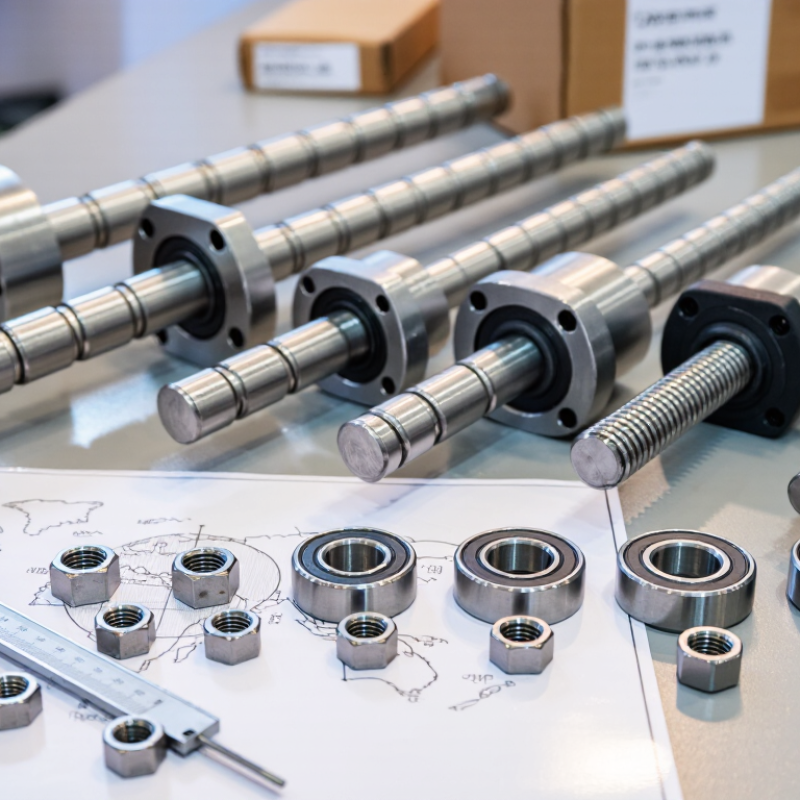
7 Best Threaded Linear Shafts for Global Buyers?

What Are Threaded Linear Shafts and How Do They Work?

7 Best Threaded Linear Shafts for Global Buyers?

Threaded linear shafts convert rotary motion into controlled linear movement. A motor turns the shaft, while a threaded nut travels along its helical profile. Pitch decides speed. A 5 mm pitch moves five millimeters per revolution, ignoring slip and compliance. Smaller pitches usually improve positioning control, but they reduce travel speed. The shaft, nut, bearings, lubrication, and motor must work as one system.

This mechanism appears in actuators, adjustment tables, packaging equipment, and laboratory instruments. MarketsandMarkets’ 2024 Linear Motion Market report forecasts growth from about USD 10.8 billion in 2023 to USD 16.4 billion by 2028. That expansion reflects wider automation adoption, but it does not make every shaft suitable. A compact shaft may handle moderate loads well, yet fail under side loading or poor alignment. Not every shaft fits.

Buyers should compare nominal load, critical speed, straightness, thread accuracy, corrosion resistance, and operating temperature. ISO 3408 provides performance terminology and testing guidance for ball screws, which helps buyers distinguish measured accuracy from marketing claims. A plain threaded shaft may cost less, but it often creates more friction and heat than a recirculating-ball design. The choice depends on duty cycle, not appearance. Small errors matter. In practice, I would request load-life calculations, tolerance drawings, and test conditions before approving a global order. Catalog ratings can mislead when lubrication, mounting, and unsupported length remain unclear. That is an uncomfortable gap, but it deserves attention.

Key Factors for Comparing Threaded Linear Shafts Globally

7 Best Threaded Linear Shafts for Global Buyers?

Choosing among seven threaded linear shafts requires more than comparing price. Global buyers should define load, stroke, speed, and operating conditions before requesting quotes. A shaft carrying a 300-kilogram assembly needs different support from one guiding a light sensor. Measure thread diameter, pitch, effective length, and straightness tolerance. Check whether the nut and shaft use matching thread forms. Small mismatches can create backlash, heat, or early wear. Keep units consistent. Mixing inches and millimeters is avoidable.

Material selection should reflect real exposure, not just catalog appearance. Hardened alloy steel suits repeated loads and high contact stress. Stainless steel may work better near washdown areas, chemicals, or humid ports. However, corrosion resistance varies by grade and surface treatment. Ask for hardness data, runout records, and inspection methods. A reliable supplier should explain how measurements were taken. Request drawings, sample reports, and traceability documents. These records make technical claims easier to verify across borders.

Compare thread accuracy, lubrication needs, mounting options, and replacement availability. Confirm that packaging protects the shaft from bending, moisture, and impact during transport. Lead time matters, but stable quality matters more. Clarify tolerances in writing. Avoid vague phrases like “industrial grade.” I have seen attractive specifications fail when mounting space was ignored. That lesson deserves attention. A short trial installation can reveal noise, binding, or unexpected deflection before a larger order is released. Also evaluate documentation language, customs data, and after-sales response. A low quote can become expensive when one missing dimension delays production.

7 Best Threaded Linear Shafts for Global Buyers? - Key Factors for Comparing Threaded Linear Shafts Globally

Rank Threaded Shaft Type Typical Nominal Diameter Typical Lead / Pitch Typical Efficiency Backlash Characteristics Typical Accuracy Class Load and Speed Profile Common Materials Relevant Standards or Specifications Best-Fit Applications Global Buying Considerations
1 Ground Ball Screw 8–80 mm 2–20 mm per revolution Approximately 90–95% Very low; preload can reduce backlash to near zero Commonly C3–C5; approximately 8–23 μm/300 mm lead deviation, depending on grade High load capacity and high positioning speed; suitable for demanding duty cycles Hardened alloy steel shaft; bearing steel balls; optional corrosion-resistant versions ISO 3408; accuracy and preload class must be specified CNC machine tools, precision stages, inspection equipment, robotics Confirm preload, lubrication, straightness, end machining, inspection report, and transport protection
2 Rolled Ball Screw 8–80 mm 2–40 mm per revolution Approximately 85–95% Low to moderate; preload and nut design determine the final value Commonly C5–C7; approximately 23–50 μm/300 mm lead deviation, depending on grade High speed and good repeatability; generally more economical than ground designs Hardened alloy steel; stainless options for selected sizes and environments ISO 3408; supplier should state lead accuracy and dynamic load rating Automation equipment, electric actuators, packaging machinery, general CNC systems Compare rated life, nut return system, allowable speed, noise level, and replacement availability
3 Miniature Ball Screw 4–16 mm 0.5–10 mm per revolution Approximately 85–93% Low when preloaded; sensitive to contamination and installation error Typically C5–C7, subject to supplier specification Moderate load capacity with high precision in compact assemblies Precision alloy steel; stainless steel options may be available ISO 3408 principles; miniature dimensions and tolerances are often supplier-defined Medical devices, laboratory instruments, optical equipment, compact robots Check minimum dynamic load rating, ball circulation design, cleanliness, and customized end machining
4 Metric Trapezoidal Lead Screw 6–100 mm 1–20 mm per revolution Approximately 30–60% Moderate; clearance is normally required for reliable operation Typically medium precision; exact tolerance depends on screw and nut grade High static load capability; low to moderate speed; may be self-locking at low lead angles Carbon steel, alloy steel, stainless steel, bronze, or engineering polymer nuts ISO 2904 and ISO 2905; common forms include Tr8×1.5 and Tr12×3 Lifting mechanisms, linear slides, fixtures, valves, and general automation Metric compatibility, nut material, lubrication interval, wear allowance, and corrosion protection are critical
5 Acme Threaded Lead Screw 0.25–4 in 2–20 threads per inch; multi-start options available Approximately 30–60% Moderate; adjustable nuts can compensate for wear Medium precision; tolerance class and backlash should be stated on the drawing Good load capacity and durability; moderate speed; may provide self-locking behavior Steel, stainless steel, bronze, and polymer nut materials ASME B1.5; inch dimensions should not be mixed with metric nut components Industrial actuators, machine slides, jacks, clamps, and legacy equipment Verify inch thread form, starts, pitch diameter, nut fit, duty cycle, and regional availability
6 Square-Thread Power Screw 10–100 mm or 0.5–4 in Application-specific; commonly 2–12 mm per revolution Approximately 45–75% Low theoretical sliding loss, but backlash depends on nut clearance and wear Design-specific; no universal dimensional accuracy class High axial load efficiency; usually slower and more difficult to manufacture Steel shaft with bronze, brass, or polymer nut Usually drawing-controlled; thread geometry, clearance, and inspection method must be defined Heavy-duty jacks, presses, laboratory mechanisms, and custom machinery Best for custom designs; require detailed technical drawings and supplier quality control
7 Planetary Roller Screw 5–120 mm 1–20 mm per revolution Approximately 80–90% Very low with preloaded configurations High precision; exact lead accuracy is supplier- and design-specific Extremely high load density, shock resistance, and acceleration capability Hardened alloy steel; specialized roller and nut components Supplier-specific geometry; specify rated life, preload, load rating, and inspection requirements Aerospace systems, heavy-duty actuators, industrial presses, and high-force automation Higher purchase cost and tighter assembly requirements; confirm service capability and spare-part continuity
Note: The dimensional ranges, efficiency values, and accuracy figures are typical engineering ranges for comparison purposes. Actual performance depends on diameter, lead, preload, nut design, lubrication, mounting accuracy, operating temperature, load direction, duty cycle, and manufacturing grade.

Seven Leading Threaded Linear Shaft Types for Different Applications

7 Best Threaded Linear Shafts for Global Buyers?

Seven Leading Threaded Linear Shaft Types for Different Applications

Choosing a threaded linear shaft depends on load, speed, accuracy, environment, and maintenance access. In field installations, I measure the full travel before selecting thread size. A small mistake here can cause binding, noise, or uneven motion.

Acme threaded shafts suit lifting platforms, clamps, and adjustable fixtures. Their broad threads handle moderate loads and tolerate dust better than finer designs. Trapezoidal threaded shafts offer similar strength with standardized profiles for industrial positioning. Ball screw shafts reduce friction and support fast, precise movement in CNC equipment and automation systems. They need cleaner surroundings and proper lubrication. They are not always the best choice.

Stainless steel threaded shafts resist moisture in food-processing equipment, laboratory frames, and outdoor mechanisms. Hardened steel shafts perform well under repeated loads and abrasive contact. Miniature threaded shafts fit compact medical devices, camera stages, and small inspection tools. Hollow threaded shafts reduce weight and provide space for cables, sensors, or fluid lines. Anti-backlash threaded shafts improve repeatability in positioning assemblies, although their preload can increase drive torque. Always verify pitch accuracy, straightness, corrosion resistance, and compatible nuts. A shaft may look strong, yet poor alignment can shorten its service life. Testing under the real operating load remains essential.

Materials, Sizes, Accuracy, and Compatibility to Evaluate

7 Best Threaded Linear Shafts for Global Buyers?

Materials, Sizes, Accuracy, and Compatibility to Evaluate

Choosing a threaded linear shaft starts with its working environment, not its catalog ranking. Hardened carbon steel suits high-load guides and repeated travel. Stainless steel performs better near moisture, cleaning fluids, or outdoor equipment. However, corrosion resistance can reduce hardness or increase cost. Check the actual grade, surface treatment, and hardness value before comparing prices.

Size selection must match the bearing, housing, and threaded connection. Measure shaft diameter, usable length, thread length, and shoulder dimensions. Metric and inch threads are not interchangeable, even when their diameters appear similar. Verify pitch, thread class, end chamfer, and mating nut specifications. For accurate motion, review straightness, roundness, surface roughness, and diameter tolerance. A polished surface alone does not prove precision. That assumption causes avoidable failures.

Tips: Request inspection reports for diameter, hardness, and straightness. Confirm the thread standard in writing. Test one sample with the actual bearing and nut before placing a larger order. Leave room for thermal expansion in long assemblies. It is easy to overlook.

Compatibility also depends on load direction, speed, lubrication, and alignment. A shaft may meet the stated tolerance yet bind because the supports are misaligned. In practical sourcing, packaging deserves attention too. Long shafts can arrive bent after poor handling. I would evaluate protective tubes, end protection, replacement availability, and documentation as carefully as the material itself. The “best” option is rarely the most expensive one.

Global Buying Considerations: Standards, Suppliers, Costs, and Shipping

7 Best Threaded Linear Shafts for Global Buyers?

Global buyers should compare seven practical options: stainless steel shafts, carbon-steel shafts, alloy-steel shafts, ground-thread shafts, rolled-thread shafts, hollow shafts, and corrosion-resistant coated shafts. The best choice depends on load, travel speed, humidity, and maintenance access. Ground threads support tighter positioning, while rolled threads usually reduce cost. Hollow shafts can lower moving mass, but their stiffness requires careful checking. Ask suppliers for thread tolerance, straightness, hardness, surface finish, and material certificates. Standards such as ISO, DIN, and ASTM can guide comparisons, but the same standard may not cover every performance detail.

Supplier evaluation needs more than a polished catalog. Request inspection records, sample measurements, production capacity, and a clear drawing approval process. I prefer suppliers that explain rejected-part handling and packaging methods. That behavior often reveals more than sales language. Confirm whether dimensions use metric or inch threads. A small mismatch can stop assembly completely. It happens.

Costs include more than the unit price. Calculate machining, tooling, certificates, protective oil, packaging, freight, insurance, customs charges, and possible import taxes. Compare landed cost, not quotation cost. For shipping, specify shaft length, crate requirements, moisture protection, and acceptable delivery variance. Long shafts can incur unusual freight charges because of oversized packaging. Air freight is faster, but sea freight may suit planned production. I have seen buyers save five percent on parts and lose weeks through unclear documents. A written inspection plan helps, although it will not prevent every mistake.】【。

7 Best Threaded Linear Shafts for Global Buyers

This comparison uses commonly specified coarse-thread configurations: ISO metric threads and Unified coarse threads. Nominal diameter and thread pitch are based on recognized standard designations, helping buyers compare compatibility, availability, and machining requirements across regions.

Metric sizes are often preferred for international sourcing, while UNC sizes remain widely used in North American equipment. Final purchasing decisions should also verify material, straightness, surface finish, allowable load, supplier quality documentation, landed cost, packaging, and shipping lead time.

CONTACT US