
7 Tips for Buying Vegan Gelatine Powder
Choosing Vegan Gelatine Powder can feel simple until two bags make different promises. One may set a glossy fruit glaze; another may leave a soft pudding loose. The label matters. So does the recipe.
Food scientist Bryan Quoc Le is a useful reference for ingredient-focused thinking. A paraphrased takeaway, not a verified direct quotation, is: assess an ingredient by its composition, purpose, and performance—not by its front-label claims. That principle guides these seven buying tips. Check the source ingredients, confirm the powder suits your recipe, and read the preparation directions before adding it to your cart. Small details count. A sample batch can reveal more than attractive packaging.
This guide also looks at texture, setting strength, flavor neutrality, serving size, and storage instructions. For example, a powder intended for firm molded desserts may not give a spoon-soft panna cotta the finish you want. Vegan Gelatine Powder is not one uniform product, and plant-based gelling ingredients can behave differently. Compare like with like. Still, ingredient lists do not tell the whole story; brands may give limited details, and real results can vary with heat, acidity, and dosage. That uncertainty deserves attention. Use these tips to ask better questions, test carefully, and choose a powder that fits your actual kitchen—not just the picture on the packet.
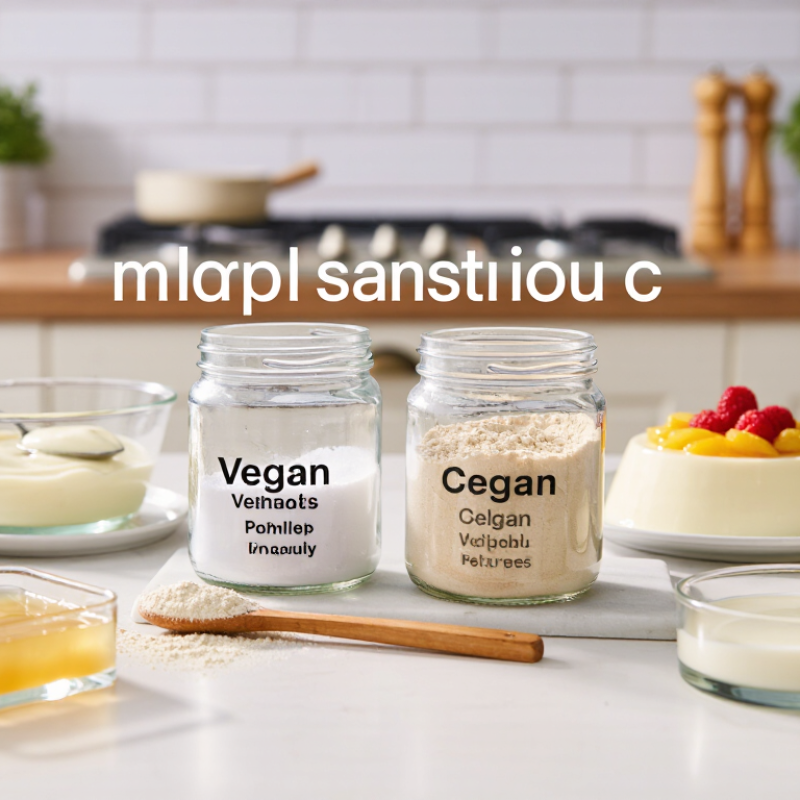
Understand What Vegan Gelatine Powder Is
Vegan gelatine powder is a plant- or seaweed-derived setting ingredient, not a direct animal-gelatin substitute. Products may contain agar, carrageenan, pectin, konjac, or a blend. Each behaves differently in a recipe. Not interchangeable.
Agar often sets firmly as it cools and may feel less springy than animal gelatin. Pectin can depend on the fruit, sugar, and acidity in a recipe. Some carrageenan blends create softer textures, but the other ingredients matter. Check the ingredient list and preparation directions rather than relying on the word “vegan” alone. A clear label helps you understand what is doing the setting.
For a first try, choose a recipe written for the powder you have. Note the amount, liquid, heating time, and cooling conditions; small changes can affect texture. A spoonful tested in a chilled dish can reveal whether a mixture sets before you commit a whole batch. I used to treat all setting powders as equivalent, which made troubleshooting harder. It is an easy assumption to make, but not a reliable one. If the result is too firm or too soft, adjust one variable at a time and record what changed.
| Tip | What to Check | Practical Buying Guidance |
|---|---|---|
| 1. Understand what “vegan gelatine” means | Gelatine is an animal-derived protein. Vegan gelatine-style products use plant- or seaweed-derived gelling ingredients instead. | Read the ingredient list to identify the actual gelling agent, such as agar, pectin, carrageenan, or konjac. These ingredients behave differently from one another and from gelatine. |
| 2. Match the gelling agent to your recipe | Agar is commonly used for firm gels; pectin is often used in fruit preserves; carrageenan and konjac are used in various foods for gelling or thickening. | Choose a product intended for your recipe type. A plant-based gelling agent is not automatically a one-for-one substitute for animal gelatine. |
| 3. Check the ingredient list | Look for the named gelling ingredient and any additional ingredients, such as sugars, salts, acidity regulators, or starches. | If you need a single-ingredient product, confirm that the label lists only that ingredient. Check the full list rather than relying on the product name alone. |
| 4. Verify suitability for vegan diets | Review any vegan suitability statement and check for animal-derived ingredients or processing information relevant to your needs. | If a vegan certification is important to you, look for a recognized certification mark and verify its details. A “plant-based” description alone may not answer every dietary question. |
| 5. Read the preparation directions | Different gelling agents can require different amounts, hydration steps, heating, or cooling conditions. | Follow the product’s own instructions and test a small batch before making a large quantity. Do not assume that directions for one type of powder apply to another. |
| 6. Consider texture and setting behavior | Plant-based gelling agents can produce textures that range from tender to firm, and some set or melt differently from gelatine. | Use a product whose stated texture suits the dish. For example, agar-based gels generally set more firmly than traditional gelatine gels, so recipe adjustments may be needed. |
| 7. Check storage, quantity, and value | Compare the net weight, storage directions, package seal, and any use-by or best-before date. | Store the powder as directed and keep it dry. Compare products by the quantity needed for your recipe, not only by package size or shelf price. |