2026 Top Industrial Cutting Machine Types for Buyers?
In 2026, choosing an Industrial Cutting Machine means matching the process to the material, required accuracy, and daily production volume. Buyers may compare fiber laser, plasma, waterjet, oxy-fuel, and mechanical cutting systems. Each handles different jobs, and no single machine is best for every workshop.
Fiber lasers can produce precise cuts in many sheet metals, while plasma systems are often considered for conductive metals and thicker stock. Waterjet cutting uses a high-pressure stream, sometimes with abrasive, and avoids the heat-affected edge associated with thermal processes. Oxy-fuel equipment is suited to certain thick ferrous materials, but it is not a universal choice. Shears and saws remain practical for straight cuts and repeatable blanks. Simple tools still matter.
A useful comparison should look beyond the machine’s purchase price. Check the material range, thickness limits, cut quality, kerf, setup time, and expected throughput. Ask suppliers to demonstrate cuts using samples similar to your own parts. Review maintenance needs, operator training, extraction or water-handling requirements, and access to local service. These details can change the real cost of ownership.
Specifications deserve a second look. Published speeds may depend on material grade, thickness, and finish requirements, so treat them as test conditions rather than promises. This guide introduces the main industrial cutting machine types and explains where each may fit. The final choice should follow measured production needs, not a technology trend. One trade-off is easy to miss: a faster cut may still require more finishing.
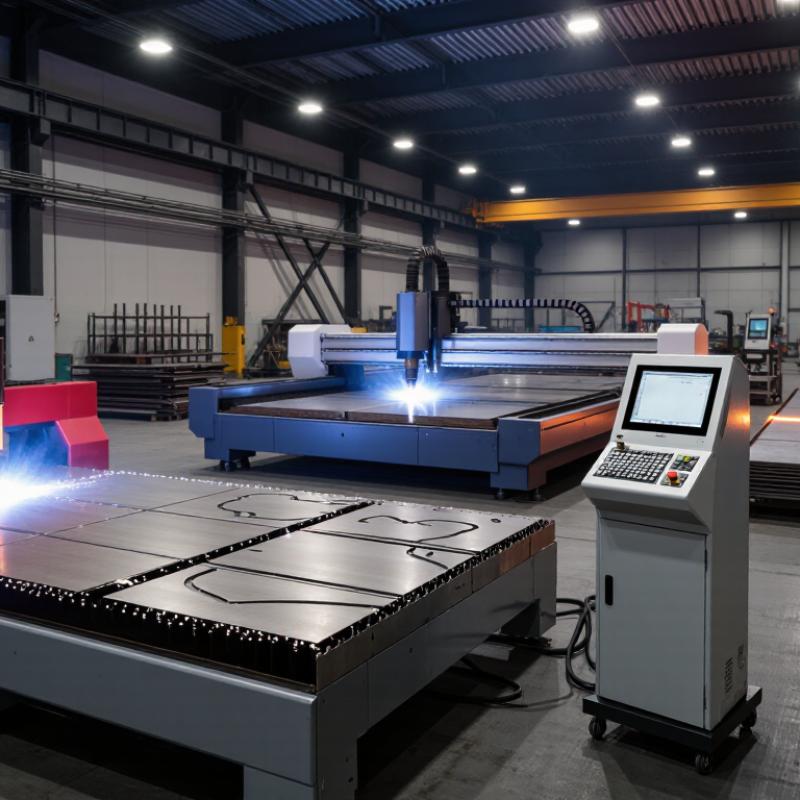
Industrial Cutting Machines: Core Functions and Operating Principles
Industrial cutting machines separate raw material along a programmed or manually guided path. Their core function is controlled material removal, with accuracy shaped by the tool, workpiece, and setup. A CNC controller converts a digital drawing into coordinated movement. The cutting head follows that path while feed rate and cutting energy are adjusted. Small offsets matter.
Different machines use different physical principles. Laser systems focus light to melt or vaporize material, while plasma systems use an electrically conductive gas to cut metals. Waterjet machines direct a high-pressure stream, sometimes mixed with abrasive, and avoid a heat-affected edge. Mechanical shears and saws rely on direct force or moving teeth. Each method leaves a different kerf, edge finish, and amount of waste.
Operators check material thickness, surface condition, and required tolerances before choosing a process. They also secure the sheet, set the cutting parameters, and verify guarding and extraction systems. During operation, sensors and test cuts can reveal drifting alignment or unstable feed. A clean drawing does not guarantee a clean cut. Setup records are sometimes incomplete, so careful inspection still matters. The best process is the one that meets the part’s needs reliably, not simply the fastest one.
Major Types of Industrial Cutting Machines in 2026
Major types of industrial cutting machines in 2026 include mechanical, thermal, and waterjet systems.
Mechanical options—shears, band saws, and abrasive saws—suit repeatable cuts in sheet, bar, and structural stock. They are often practical for thick sections, though blade wear can affect edge quality.
Thermal machines use lasers, plasma, or oxy-fuel. Lasers offer narrow kerfs and detailed profiles in sheet metal; plasma handles conductive plate quickly, while oxy-fuel remains useful for thick carbon steel.
Waterjets cut without a heat-affected zone, a clear advantage for heat-sensitive materials. They use high-pressure water, sometimes mixed with abrasive. Fit matters more.
MarketsandMarkets’ 2023 Laser Cutting Machines Market report estimated a USD 5.0 billion global market in 2023, projecting USD 6.3 billion by 2028. This forecast signals investment interest, not a guarantee that laser cutting suits every shop.
The International Federation of Robotics’ World Robotics 2024 report recorded 541,302 industrial robot installations worldwide in 2023. That broader automation trend matters: cutting cells increasingly pair machines with loading and sorting systems.
Buyers should compare material, thickness, tolerances, operating costs, and planned throughput. A fast machine may still sit idle if part loading is slow. Real production trials help reveal that gap.
Materials and Applications Matched to Each Cutting Technology
Matching a cutting process to the material can save time, reduce scrap, and produce cleaner edges. Fiber lasers are commonly used for carbon steel, stainless steel, and aluminum sheet. They suit detailed profiles and repeatable parts, such as electrical enclosures or brackets. CO2 lasers often handle acrylic, wood, textiles, and some plastics. A clean edge matters. Check material thickness and surface coatings before choosing; reflective metals may need specific equipment settings.
Plasma cutting works well on conductive metals, especially medium-to-thick steel plate used for frames or structural parts. Its cut may be rougher than a laser’s, so allow for finishing when tolerances are tight. Waterjet systems cut stone, glass, composites, and metals without a heat-affected edge. They can help with heat-sensitive parts, though abrasive use and slower cutting can raise operating costs. Oxy-fuel cutting is suited to thick carbon-steel plate and large components, but it is not a choice for aluminum or stainless steel. No chart is perfect. A small test cut can reveal burrs, warping, or edge quality that a specification sheet cannot predict.
Key Performance Factors for Comparing Machine Types
Comparing industrial cutting machines starts with the part, not the headline speed. Laser cutters suit intricate profiles and narrow kerfs, but heat can affect thin or heat-sensitive materials. Plasma handles conductive plate efficiently, while waterjet avoids a heat-affected zone and can cut materials that thermal processes cannot. Mechanical shearing is productive on straight cuts, but offers less shape flexibility. No type wins every job.
Run a practical test using the same material, thickness, and nesting pattern. Record finished parts per shift, dimensional variation, edge quality, setup time, and consumable use. ISO 9013:2017 provides a framework for assessing thermal-cut quality, including angular deviation and surface roughness. It does not cover every process, so compare waterjet and mechanical cuts with suitable process-specific checks. Small details matter: a rough edge may add grinding time, even when the cut itself looks fast.
Operating cost needs a measured basis. The U.S. Energy Information Administration reported an average industrial electricity price of 8.14 cents per kilowatt-hour in 2023; this is a broad benchmark, not a machine-specific rate. Track actual power draw, assist gas, abrasive, tooling, and maintenance during trial runs. One awkward truth: quoted cycle times may exclude loading and rework. I would compare those figures separately, then check whether the machine can hold tolerance across a full production shift.
How Buyers Can Match a Machine to Production Requirements
Choosing an industrial cutting machine starts with the parts you make, not a catalogue. Record material, thickness, daily quantity, tolerance, and acceptable edge quality.
Measure the real parts.
A laser cutter can suit detailed profiles in sheet metal. Plasma cutting may be practical for thicker conductive plate and faster rough cuts. Waterjet systems handle heat-sensitive materials without a heat-affected edge, but abrasive use and slower throughput can increase costs. Mechanical shearing works well for repeated straight cuts, though it cannot produce complex contours.
Then compare the machine’s capacity with actual orders, including occasional jobs that fall outside the usual range. Ask for sample cuts using your material and thickness. Check kerf width, edge condition, dimensional accuracy, and cutting time; brochure specifications alone may not predict results on your shop floor.
Estimate consumables, energy, maintenance, operator training, and space for loading material and removing finished parts. Automation can help with steady production, but it may add cost and setup demands when orders vary.
There is no perfect match. I would revisit the choice after a trial run, because production schedules and product mixes can change.